In This Article
QUICK ANSWER
What Belongs in a Bakery Fillings and Toppings Plant Plan?
Plan the complete product route: ingredient preparation, cooking or blending as required, transfer, approved holding or cooling, packing and cleaning. The cooker is one package within that route. Its usable output depends on formulation, receiving readiness and turnaround, while building services and installation access can materially change the capital scope.
Start a bakery fillings manufacturing plant study with the actual product range and customer delivery form. Connect each process decision to equipment interfaces and utilities before comparing installed-cost alternatives. Establish product-specific thermal, handling and release requirements with the responsible specialists.
Fruit fillings, chocolate toppings and other bakery components can share a market without sharing an identical manufacturing duty. Particle handling, formulation, batch size and the way product reaches a bakery line or customer container can change the appropriate process arrangement.
The differences become especially important when a facility supplies several bakery lines or serves customers in different container sizes. The receiving calendar can vary even when the central recipe is similar. An owner evaluating a new plant or an existing bakery expansion should therefore ask what becomes saleable at the end of the route, not simply how large a cooker can be purchased. DPS's cooking-vessel, engineering and field-integration capabilities can be applied to those defined decisions rather than presented as a generic equipment list.
1. Define the Product Range and Customer Delivery Form
Describe each planned product in engineering terms. Record its formulation family, physical character, particle requirements, batch quantity and the condition required at the next operation. Keep the product's actual process and food-safety basis separate from assumptions made for a preliminary capital estimate.
Define whether the product feeds an internal bakery process, enters a finished retail pack or leaves in a business-to-business delivery unit. Each route changes the receiving duty and operating calendar. A vessel that discharges into an adjacent process is not performing the same handoff as one feeding containers for later distribution.
Group products only where the shared arrangement has been justified. A family name such as fruit filling does not establish that every recipe uses the same transfer, agitation or cleaning conditions. Identify the products that are likely to control equipment selection and the smaller products that may challenge minimum batch operation.
Include the demand pattern. Seasonal or promotional recipes can require many short runs even when annual volume is modest. Longer campaigns may improve equipment utilization while increasing inventory or reducing product responsiveness. That tradeoff belongs in the business model.
The initial deliverable should connect product, quantity, required process and delivery form. Suppliers can then explain which requirements affect their package and which need product trials. This is a more useful starting point than asking several vendors for a nominal vessel size and assuming their proposed systems serve the same duty.
2. Specify the Cooker with Its Discharge and Cleaning Interfaces
DPS's kettles and cookers offering connects vessel fabrication with formulation, agitation, steam and condensate, CIP, transfer and recipe controls. Use that scope to define the entire operating cycle rather than treating heating as the only capacity event.
For each controlling recipe, establish the usable batch and required product behavior with the appropriate specialists. The supplier needs to understand the formulation and intended handling, not simply a mass-per-hour target. Any thermal process must be supported for the actual product; a generic cooker setting is not a plant design basis.
The discharge destination should be named in the enquiry. Define how it becomes ready, what product conditions it accepts and what happens if it stops. A cooker can finish its processing stage yet remain occupied because the transfer or receiving operation is unavailable.
Connect the cleaning boundary to that same cycle. Identify which vessel, transfer line and destination are included, which resources are shared and when the asset becomes available for another product. Keep cleaning requirements intact when testing a shorter turnaround.
Ask the bidder to identify the data it still needs before confirming duty. A product trial, receiving specification or utility condition can be a legitimate release prerequisite. Making it visible early is better than allowing an uncertain interface to become an unpriced field assumption.
3. Calculate Batch Output from Complete Vessel Occupancy
A batch-capacity comparison must include the time the asset remains unavailable for the next batch. Use a complete occupancy sequence for the selected product and identify whether any activities can genuinely overlap. Do not add independent durations mechanically if the actual arrangement supports a different sequence.
In an invented twelve-hour example, each 600-kilogram batch uses two hours for the assumed base processing activities and half an hour for cleaning. A half-hour transfer gives a three-hour cycle, allowing four batches or 2,400 kilograms. A one-hour transfer gives a three-and-a-half-hour cycle, allowing only three complete batches or 1,800 kilograms within the window.
| Quantity | Faster Transfer | Slower Transfer |
|---|---|---|
| Base processing | 2 h | 2 h |
| Transfer | 0.5 h | 1 h |
| Cleaning | 0.5 h | 0.5 h |
| Complete cycle | 3 h | 3.5 h |
| Complete batches in 12 h | 4 | 3 |
| Batch output | 2,400 kg | 1,800 kg |
Check where the assumed transfer time comes from. It may reflect the package itself, a shared receiving route or waiting for containers. A faster pump cannot remove time caused by a destination that is not ready, and the product's handling requirements constrain any proposed change. The second scenario leaves one-and-a-half hours, which cannot produce another complete batch under these assumptions. This illustrates a calendar threshold, not an inherent equipment efficiency loss. An alternative campaign or a different operating window could change the comparison.
Illustrative complete-batch output
Half-hour transfer · 2,400 kg
One-hour transfer · 1,800 kg
The investment question is whether a receiving or transfer improvement removes the lost batch more effectively than buying another cooker. Preserve the required product conditions and cleaning process while testing that option, and confirm the real duty before treating the arithmetic as an operating commitment.
4. Treat Holding, Cooling and Packing as Receiving Duties
The next operation determines when the cooker can discharge. Establish the selected product's required holding or cooling route and the receiving conditions before choosing a transfer arrangement. Do not assume that an available container creates an acceptable product buffer.
For an internal bakery customer, align batch release with the point where the filling or topping is used. A line interruption can propagate upstream if the shared holding position remains occupied. The production model needs the product's permitted conditions and response to that interruption, not just an average consumption rate.
For packed ingredients, include filling, container availability, identification and removal from the packing area. The usable batch output must fit the actual delivery unit, with any residual product and changeover requirements understood. Container handling can constrain the route even when the cooking vessel is available.
Map the interface quantities carefully. A recipe mass, vessel usable quantity, pack count and shipped unit describe different stages. Keep the conversion visible so a change in customer pack does not silently alter the downstream capacity assumption.
The DPS process-engineering service can connect the flow diagrams, equipment documentation, layout and controls requirements around that handoff. Request a defined response to an unavailable destination and a traceable link between product release and the next batch.
That makes transfer investment reviewable. The owner can see which receiving constraint is removed and whether the proposed improvement supports the commercially required product calendar.
5. Build Utility Scope from the Timed Batch Sequence
Use the batch calendar to identify simultaneous utility demands. Heating, ingredient preparation, transfer, cleaning and other consumers may overlap differently across product families. The relevant duty includes required service conditions at the connected equipment, not merely annual consumption or a sum of unrelated nameplates.
Define the steam and condensate boundaries where the selected cooker uses them. Identify supply conditions, connection responsibilities and the return arrangement with the responsible engineers. A package quotation that stops at a vessel connection does not include every field requirement needed to make that connection useful.
Connect water, electrical, refrigeration where required and drainage arrangements to the actual process. A new product route can change when services are needed and where material or cleaning returns must go. Avoid assuming an existing building is suitable because its original bakery operation used similar service names.
Give layout and building designers the significant loads and connection points early enough to coordinate the routes. Reserve access for installation and later operation, including the work needed around existing services in a retrofit.
Review the limiting operating case rather than the busiest machine in isolation. A cleaning event coinciding with the next batch preparation may control the service requirement. If an alternative sequence is proposed, verify that it preserves required production and cleaning conditions.
The output should be a coordinated utility basis linked to the equipment list and operating model. That basis helps turn a process concept into a defensible installed-capital estimate.
6. Investigate Underground and Service Work Before Fixing the Outage
The useful lesson is that bakery investment can be controlled by enabling construction rather than the visible processing package. A new fillings route may depend on service changes or underground work that is difficult to perform beside operating production. Investigate those conditions before treating equipment delivery as the start of the project schedule.
This account is a facility-overhaul example, not evidence that DPS installed a particular fillings system there. Apply its scope lesson to the new project: identify what must be exposed, relocated or connected before the selected product route can operate.
For an existing site, distinguish preparatory work from work that needs the released production area. Define the access, isolation, verification and restart prerequisites for that boundary. Do not call an outage zero downtime merely because some other activities can continue.
DPS's general-contracting scope connects process-critical installation with piping, controls, commissioning and managed specialist building trades. A focused enquiry should ask how the service and building work changes the feasible sequence and the owner's interruption exposure.
The capital decision then includes the work necessary to receive and operate the equipment. That can materially change the comparison between reusing an existing area and creating a better-connected new one.
7. Compare a Retrofit vs a Dedicated New Process Area
An existing bakery area may offer proximity to the consuming line and familiar services. A dedicated new area may offer a cleaner installation sequence and a better arrangement for future products. Compare those benefits against actual site constraints rather than assuming reuse is always the cheaper route.
| Decision | Retrofit Existing Area | Dedicated New Area |
|---|---|---|
| Process relationship | May shorten connection to current use | Can arrange the selected route deliberately |
| Service work | Existing capacity and access need investigation | New distribution and connections need scope |
| Execution | Operating-area interruptions may control | Final tie-ins still need a planned boundary |
| Expansion | Constrained by retained infrastructure | Future access can be designed early |
Price the differences generated by the chosen process: transfer distance, utility distribution, drainage, cleaning arrangements, material movement and installation access. Equipment quotes alone may be similar while the installed alternatives differ substantially.
Review the commercial consequence of construction. A lower capital option may require an interruption that affects a critical seasonal campaign. Another may preserve more production but need additional permanent infrastructure. Put those consequences beside the price rather than hiding them in schedule notes.
Use the same product range and operating requirement for both options. If the new area supports a broader future range, identify that additional capability explicitly instead of treating it as an unexplained cost premium.
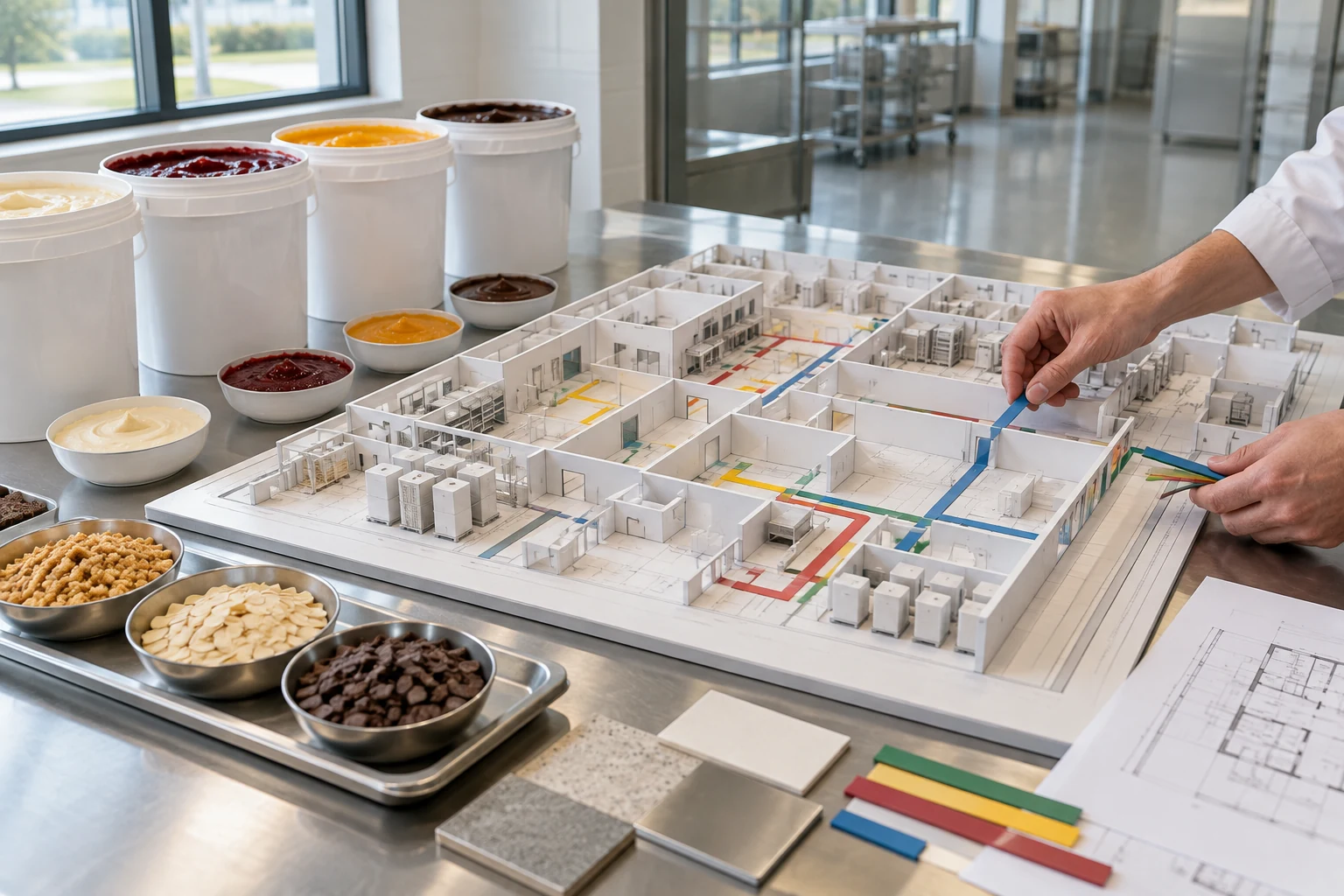
Require the estimate to state how known site information was used. An accessible service connection and an assumed buried connection are different levels of definition. Show investigation or design work needed before either option can be committed, instead of treating an unresolved retrofit condition as a completed saving.
A sensible choice has a clear causal explanation: it supports the required recipes through the selected receiving route and its construction exposure fits the business calendar.
8. Approve Capital Around the Complete Recipe-to-Delivery Route
The approval package should connect the product matrix, batch calendar, cooking specification, receiving duty, cleaning boundary and utility basis. Every major cost should be traceable to a defined operation or enabling requirement. This prevents a nominal cooker price from becoming the whole project budget by default.
Ask DPS and specialist suppliers for a coordinated equipment and field-scope review. Identify where vendor data is still needed and which product decisions affect procurement release. A confirmed recipe or a clarified destination can be more valuable at this stage than a prematurely detailed equipment selection.
Compare investment options using complete batches and saleable delivered units within the intended calendar. Keep quality, release and permitted process conditions inside the operating basis. A faster apparent cycle is not useful if it depends on an unsupported product holding or cleaning assumption.
Separate initial capability from future flexibility. Reserve a later receiving position, service route or product branch only where it supports a credible next step. Record the trigger that would justify the additional investment and preserve the access needed to install it.
For a retrofit, carry the investigated site conditions into the estimate and execution plan. For a new build, coordinate those interfaces before the floor and distribution routes are fixed. Both need integrated commissioning responsibilities.
The resulting decision is about a workable bakery-components operation: defined recipes enter, approved processes occur and the required product reaches its intended customer. That is the appropriate standard for judging the equipment, construction and capital plan together.
Bakery Fillings Plant Planning FAQ
Can one cooker serve every filling and topping?
Establish the controlling product duties first. Formulation, particles, usable batch, agitation, transfer and required process conditions determine whether a shared package is appropriate.
Why can transfer time change batch output?
The vessel remains occupied until the required discharge and turnaround are complete. A longer receiving delay can move a complete batch outside the available production window, even when heating time is unchanged.
Should holding capacity be added before another cooker?
Test the actual constraint and permitted product route. A holding arrangement needs supported conditions and a defined receiving duty; it is not automatically an acceptable solution to waiting product.
Is an existing bakery room usually cheaper than a new area?
Investigate services, underground work, access and production interruption before comparing. Reuse can offer advantages, but retained infrastructure can also generate significant installation scope.
What should be included with a DPS cooker enquiry?
Provide representative recipes, usable batch requirements, receiving destination, operating calendar and cleaning boundaries. Include the service conditions and connection responsibilities known at the enquiry stage.
What should be decided before committing to an outage?
Identify enabling construction, isolation, prepared connections, verification and restart requirements. Confirm which work needs the released production area and which can be completed beforehand.
Sources and Calculation Notes
DPS services, equipment and project statements use the sources below. Numerical examples are original teaching calculations, not customer results, supplier quotations or sizing recommendations.
- DPS — Process Engineering & Design. Process documents, utility loads and equipment interfaces.
- DPS — General Contracting. Coordinated field execution and delivery responsibilities.
- DPS — Kettles & Cookers. Current cooking-vessel offering and interfaces.
- DPS published project — Confidential Client — Pie Bakery Facility Overhaul. Project-specific account, attributed to DPS.
Research reviewed October 27, 2026.