
In This Article
QUICK ANSWER
Should a Food Plant Buy Peak Utility Capacity or Change Its Schedule?
Buy capacity when the required operating sequence creates an unavoidable, verified demand. Compare sequencing or a properly engineered buffer when a short overlap creates the peak and the process can tolerate a different sequence. Preserve production commitments, approved cleaning conditions and required service quality. A lower peak is useful only if the revised operation remains practical.
Begin with a timed demand profile, then connect it to equipment interfaces, controls and the installation plan. Annual consumption and summed equipment ratings cannot answer this investment question alone.
A larger supply package can solve the wrong constraint. If batch preparation, production and cleaning draw from a shared system at the same moment, the limiting event may last minutes while the larger asset remains installed for years. Equally, moving an event on a spreadsheet does not prove the factory can operate that way.
Food plant utility capacity planning should compare the engineering mechanism behind each option: unavoidable simultaneous demand, shiftable work, usable storage or a changed process arrangement. This comparison is particularly valuable before site selection fixes the incoming service, or before an expansion connects new users to an operating utility network. The decision can change both the size of the investment and the production freedom available to the owner later.
1. Find the Event Creating the Peak
Identify each significant consumer, its required conditions and its operating duration. Separate normal production, vessel filling, cleaning, startup and product changeover. Place those events against the actual campaign calendar so the peak can be traced to an overlap rather than an unexplained diversity factor.
The important question is which activities must coincide. A batch vessel needed to feed the next campaign may have a fixed readiness deadline. A cleaning circuit may need to finish before a product can enter an area. Other activities may have genuine scheduling freedom. Operations and quality should establish those constraints before engineering removes an overlap.
A DPS process-engineering study can connect simultaneous utility loads with the production model, layout and control requirements. Ask for the event causing the constraint and the evidence behind its duration. That is a more actionable deliverable than an isolated maximum-demand total.
For compressed air, the DOE sourcebook similarly distinguishes demand over time from a simple average. Its storage discussion is relevant to that utility; it does not justify using the same sizing method for steam, water or refrigeration.
Keep both the routine profile and the credible limiting case. Selecting a supply system against only the quietest shift would merely move the problem into operation.
Use event start and finish conditions that operators recognize. “After the previous batch” is insufficient if cleaning, material availability and the destination vessel can each control when the next fill is permitted.
2. Treat CIP as a Circuit, Return and Control Interface
Cleaning-in-place demand is connected to the circuit being cleaned, its supply and return paths, the vessel or line boundary and the approved cleaning sequence. It is not simply the nameplate flow of a supply pump. A shared system must support the required conditions where the circuit needs them.
DPS’s current CIP equipment offering includes custom design and fabrication coordinated with vessels, piping, controls and existing equipment. For a capacity decision, that means examining the connected circuits and their return limitations before assuming a larger central package alone will improve the plant.
A lower simultaneous demand may be possible if two approved cleaning activities can run sequentially within the available window. It may be impossible if the delay would hold up the next product or conflict with another required activity. Preserve the cleaning requirement and test the proposed sequence; do not reduce required cleaning conditions to fit an undersized service.
The designer also needs to examine what the return system can accept and how the operating state is communicated. Capacity at the supply side is only one part of the arrangement. Define the signals, permissives, available destination and response when a circuit is not ready.
For shared CIP, list the production asset unavailable during each circuit. That converts a cleaning duration into a capacity consequence: the same twenty-minute task has a different business effect when it blocks a bottleneck vessel rather than an idle branch.
3. Compare Two Schedules with the Same Event Volume
Consider an invented sixty-minute water-demand example. Production draws 35 gallons per minute throughout. One cleaning event draws 50 for twenty minutes; a vessel fill draws 40 for twenty minutes. The example assumes those event durations and the production commitment are unchanged.
If cleaning and filling overlap, the peak is 35 + 50 + 40 = 125 gallons per minute. Running filling after cleaning instead produces a maximum of 85. Total consumption remains 35 × 60 + 50 × 20 + 40 × 20 = 3,900 gallons. Scheduling has changed the peak, not eliminated water use.
| Period | Overlapping Case, gal/min | Sequential Case, gal/min |
|---|---|---|
| Minutes 0–20 | 125 | 85 |
| Minutes 20–40 | 35 | 75 |
| Minutes 40–60 | 35 | 35 |
| Event volume | 3,900 gal | 3,900 gal |
The reduced peak is a candidate operating case, not a supply-system selection. The design still needs required pressure, water suitability, distribution effects, control behavior and a justified capacity provision. Most importantly, the owner must verify that postponing the fill does not starve the next production step.
Illustrative peak demand · gal/min
Overlap · 125
Sequence · 85
Same 3,900-gallon event volume; peak comparison only.
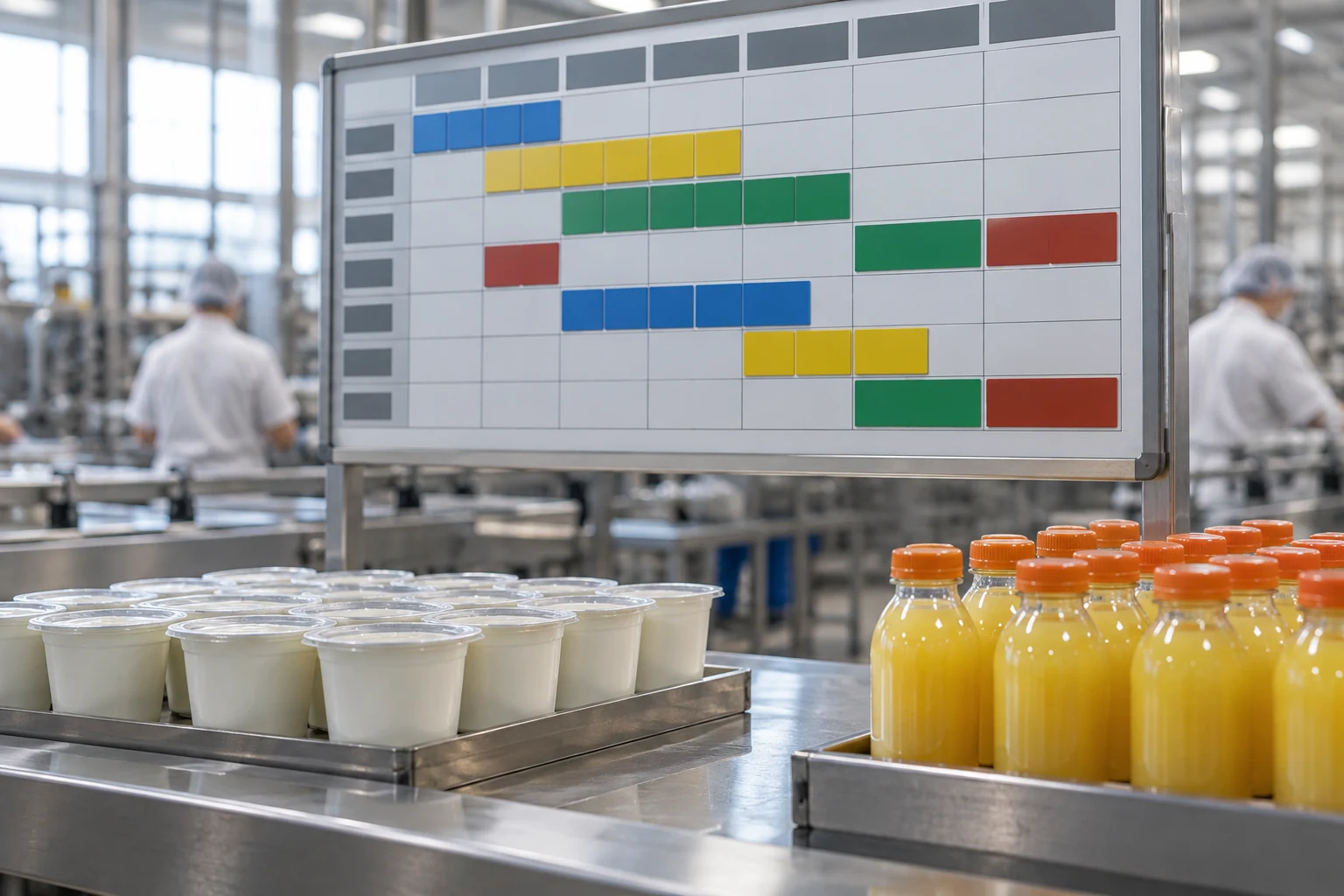
Test the boundary at minute twenty, when the delayed fill is allowed to start. If production needs that vessel before minute forty, the sequence does not preserve the original commitment. The remedy might be another vessel, a different campaign or more service capacity, and each changes the investment comparison.
The hydraulic designer also needs the required conditions during the combined event. Seventy gallons per minute at one location is not equivalent to the same flow divided among users at inadequate pressure. Keep the profile attached to the connection requirements when reviewing the supply concept.
4. Compare Capacity, Sequencing and Buffers by Their Constraints
Added capacity gives value when the concurrent demand is real and the downstream distribution can use it. Its scope may include the incoming service, generation or treatment, controls, distribution and the connection work. A larger central machine does not resolve every local limitation.
Sequencing shifts the constraint into the operating calendar. Its value depends on reliable enforcement and enough time between required events. A buffer shifts part of the requirement into inventory or stored utility, introducing usable-volume, recovery and operating-condition questions.
| Option | Works When | Investment Check |
|---|---|---|
| Add supply capacity | Required concurrent demand cannot move | Include upstream service and downstream bottlenecks |
| Sequence events | Approved activities fit a different calendar | Price control changes and any production consequence |
| Add a buffer | Stored quantity can bridge a defined shortfall | Verify usable volume, recovery and suitability |
Compare the same product program and release conditions. If an option requires fewer products, another shift or a different cleaning window, identify that as a changed business case. The apparent saving must be assessed with the consequence it creates.
A hybrid may be strongest: a modest capacity addition paired with a controlled event sequence. That conclusion needs a defined profile and actual quotations, not an assumption that the largest or smallest package is automatically the best investment.
Quantify the operating consequence in the same unit as the business plan. A scheduling option that loses an hour at the bottleneck should show the affected product volume and contribution assumption. A buffer option should show its repeat-cycle limit. A supply addition should show which constraint it removes and which remains. These descriptions reveal whether the alternatives actually deliver the same outcome before management compares the capital figures.
5. Calculate a Buffer from the Deficit and Recovery Period
A buffer bridges a mismatch between inflow and outflow over time. In a separate teaching example, an approved use draws 40 gallons per minute for twenty minutes while replenishment provides 20. The simplified usable deficit is (40 − 20) × 20 = 400 gallons.
That is not the nominal vessel size. It excludes operating limits, unusable volume, headspace, recovery behavior and the requirements of the actual fluid or product. The relevant specialists must establish whether storage is appropriate and how it is controlled. A product buffer also introduces residence-time and quality questions that a utility-only calculation cannot settle.
Check recharge before the next event. If the available interval is too short, the buffer merely postpones depletion. Several campaigns can create a cumulative deficit even when the first event appears successful. Model the complete repeating cycle, including the conditions under which inflow is available.
The physical location matters as well. A distant storage point may not provide the conditions a critical user needs. Connections, distribution and controls belong in the option estimate, alongside the vessel itself.
Give the owner the usable deficit, recharge assumption and limiting event together. Those quantities explain the proposed operating mechanism without turning a simple volume calculation into a vessel, pump or treatment specification.
Where the deficit is a utility quantity, examine the service condition during discharge. Where it is product, examine identity, temperature and permitted holding. The arithmetic may look identical while the engineering obligations differ substantially.
6. Include Tie-in Readiness in the Capacity Choice
The investment lesson is that a utility option has an execution boundary as well as a duty. A theoretically attractive replacement may require connections that the production calendar cannot accommodate without preparation. The tie-in plan therefore belongs in the capacity comparison before the owner commits to the package.
For a new project, identify the isolation points, temporary states, installation prerequisites and checks needed before an operating system is returned to service. Review what must be fabricated or prepared before the allowed interruption begins. Keep the particular operating and verification responsibilities explicit.
Translate that preparation into an option-specific work sequence. For example, a new supply branch may be prefabricated while the existing service operates, but the isolation and final connection still require a planned interruption. Identify the shared users affected by that interruption and the point when each can return to operation. An isolated installation price cannot show this difference between two capacity options.
Where the new plant is initially empty, the same discipline protects later phases. Designing accessible connection points and an activation sequence now can be more useful than assuming that future capacity will be easy to attach simply because floor space remains.
Keep outage readiness separate from installed duty. A well-prepared tie-in can shorten field exposure without proving that the selected system has enough capacity for a later operating scenario.
7. Make the Operating Rule Enforceable and Testable
If the economic case relies on nonoverlap, state what prevents overlap. The answer may involve scheduling, procedures, interlocks or a combination established by the responsible team. A preferred order on a planning sheet is not an operating function.
Specify the relevant states: which user is requesting service, whether the destination is ready, what capacity is available and how a rejected request is handled. Review the response to an interruption or a delayed event. The plant should not depend on an operator discovering the constraint after product preparation has already started.
Connect that logic to the agreed production calendar. A permissive that protects the utility but repeatedly delays filling could lower saleable output. Trial the proposed sequence against representative campaigns and define which evidence is needed before the option is accepted.
For a DPS engineering engagement, ask for the load profile, process interfaces and controls requirements to share one issue of the operating basis. Separate the supply equipment acceptance from proof that the integrated sequence supports the intended business schedule.
The handover should explain the constraint and the operating response, not merely supply a new setpoint. That information helps the owner recognize when a future product or campaign change requires a fresh capacity review.
Include an acceptance scenario in which the second user requests service early. The response should demonstrate the agreed operating rule without relying on a favorable manually arranged test sequence.
8. Approve the Option That Preserves Saleable Production
Compare installed cost, recurring cost, operating constraints and later expansion under the same output commitment. Include piping, controls, utility service changes and the planned connection work. Keep uncertain scope visible instead of crediting a low equipment price as the complete investment.
DPS’s capital-planning service can connect the operating baseline with utility scope, installed-cost scenarios and phased investment. A focused brief should ask whether a profile can be reshaped without reducing the required production calendar, and what evidence or design work remains before commitment.
Record the trigger for later capacity. If a new line or a different product mix would exhaust the available window, identify that event in the phase plan. Sequencing can be a sensible first-stage strategy without being a permanent substitute for infrastructure.
The approval package should make the causal chain clear: this event creates the peak; this option addresses it; these controls and interfaces make the option practical; this cost boundary supports the comparison. That gives the owner a decision grounded in the process rather than a contest between supply-machine ratings.
Provide bidders with the same timed profile, circuit map, return assumptions and operating constraints. Ask them to identify the extra work their option requires and the information still missing. This makes an allowance for controls or connections reviewable and prevents an apparently inexpensive supply package from winning merely because its interfaces were left outside the quotation.
Utility Capacity Planning FAQ
Does sequencing reduce water or energy consumption?
Not automatically. The water example changes a 125-gallon-per-minute peak to 85 while keeping event volume at 3,900 gallons. Consumption and cost require their own analysis.
Can a larger supply unit solve a local return restriction?
Not necessarily. Review the complete circuit, return path, distribution and control conditions. A supply rating alone does not establish useful service at every connection.
How does usable buffer volume differ from nominal tank size?
Usable volume is the inventory available to bridge the defined shortfall. Nominal vessel volume also includes quantities unavailable within the operating limits. Establish recovery, connections and product or utility suitability before selecting the vessel.
When does sequencing become too restrictive?
When required campaigns cannot finish within the available production and cleaning calendar, or delays repeatedly block the bottleneck. Model the limiting product mix and define the expansion trigger before relying on sequencing as a permanent strategy.
What belongs in the installed-capacity budget?
Include upstream service, the supply package, distribution, returns, controls and connection work appropriate to the option. Show the production effect of installation separately so a low equipment quotation does not conceal a costly interruption.
What should the owner request first?
A timed demand profile linked to production, cleaning and filling, with required conditions and critical interfaces. Use it to compare capacity, sequencing and buffer mechanisms.
Sources and Calculation Notes
DPS services, equipment and project statements use the sources below. Numerical examples are original teaching calculations, not customer results, supplier quotations or sizing recommendations.
- DPS — Process Engineering & Design. Process documents, utility loads and equipment interfaces.
- DPS — Capital Planning & Feasibility. Operating scenarios and phased investment.
- DPS — CIP Systems. Current CIP offering and circuit boundaries.
- DPS published project — Albertsons — CIP System & Air Farm Upgrade. Project-specific account, attributed to DPS.
- U.S. DOE — Compressed Air Sourcebook, Third Edition. Demand profiles and supply/demand interaction.
Research reviewed October 27, 2026.