In This Article
QUICK ANSWER · CAPITAL PLANNING
What Determines Sauce Manufacturing Plant Cost?
Sauce manufacturing plant cost depends on the product and preservation route, campaign size, packaging, site and complete installed scope. Budget ingredient preparation, cooking or other required treatment, cooling where applicable, transfers, filling, packing, cleaning, utilities, controls and facility work together. A cooker price does not establish the investment needed to supply acceptable finished sauce.
First confirm the formulation envelope and appropriate process with the relevant specialists. Then develop a cook-cool-fill operating schedule and compare proposals against the same boundary. The examples below show scope and capacity arithmetic using invented inputs; they are not market prices, process instructions or a DPS quotation.
A sauce project can appear affordable when the first budget centers on a cooker and a filler. The missing investment often sits between and around them: ingredient staging, preparation, product transfers, cooling, buffer space, cleaning, packaging supply and infrastructure. These elements also determine whether the proposed line can complete the campaigns the business expects to sell.
For an owner planning a new sauce facility, the budget should explain how a defined portfolio becomes saleable packaged product. This guide connects the manufacturing sequence with the factory’s installed scope, commercial requirements and funding plan. It is deliberately separate from recipe development and process approval; the technical suitability of each route must be established for the actual product and package.
1. Define the Sauce Portfolio Before Asking for a Plant Price
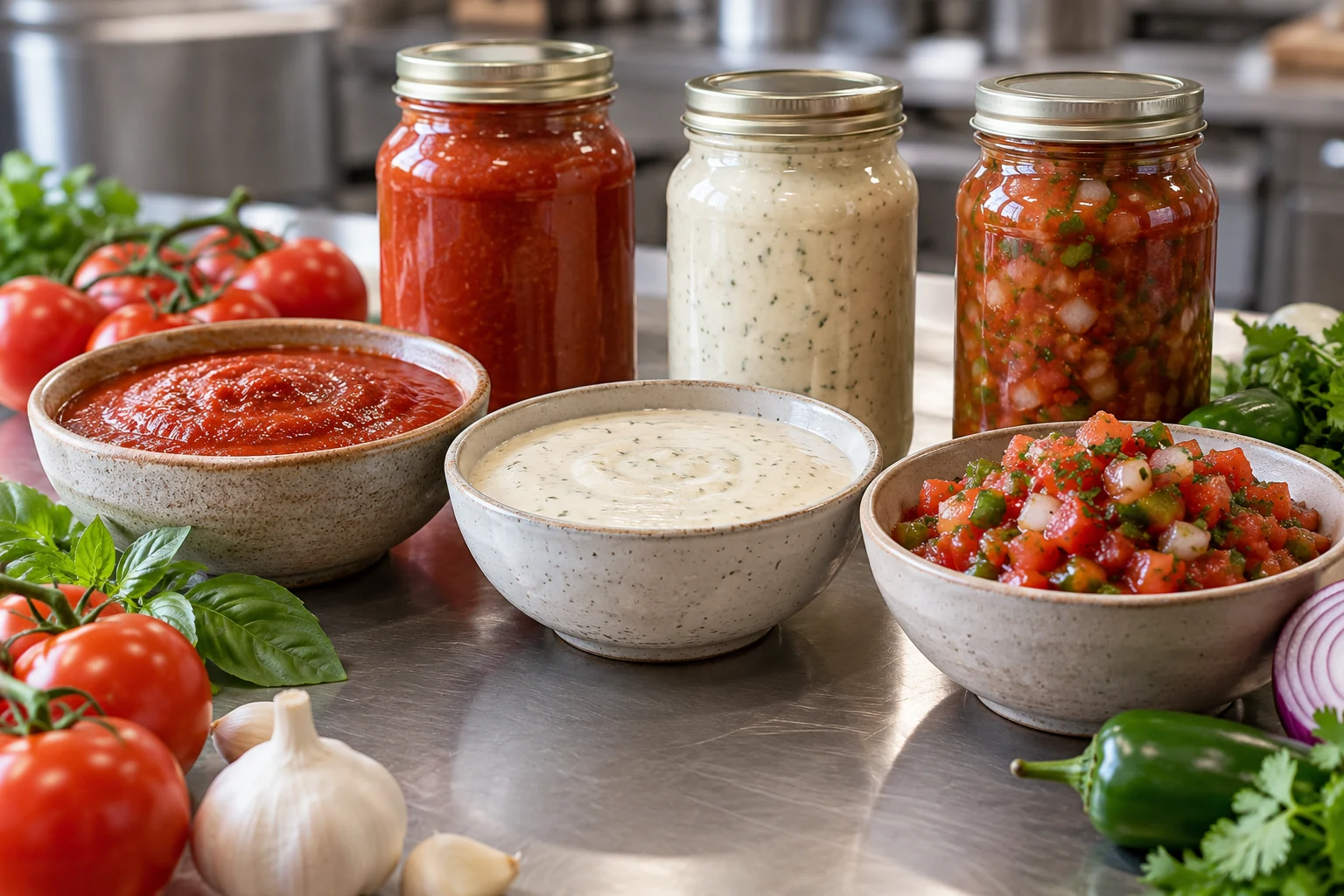
List the launch products and the meaningful differences between them. Ingredients, physical behavior, particulates, quality targets, package and storage conditions can change the manufacturing requirements. A smooth dressing, a particulate sauce and a refrigerated dip should not be assumed to share one complete process simply because all appear in the same grocery aisle.
Identify which products are mandatory at launch and which are later options. Record development status and the evidence available for each product. Where the formulation or package remains undecided, show the decision as an open input rather than selecting equipment around an assumed universal capability.
Disruptive Process Solutions (DPS) can connect an agreed product basis to conceptual process, utility and layout requirements during capital planning. The scope should make the portfolio boundary explicit, including which future products would require additional trials or capital. This gives the owner a clearer question than a generic request for the cost of a sauce factory.
2. Establish the Preservation and Packaging Route First
Have the appropriate product and process specialists identify suitable routes for the intended formulation, storage and distribution conditions. The phrase cook-cool-fill describes an operating sequence, not a food safety determination. Some products may follow a different approved sequence, and that difference can materially affect the investment scope.
FDA’s aseptic guidance illustrates the coordination required where a relevant low-acid aseptic system applies. It is not a universal description of every sauce operation. Product classification, required treatment and any process filings should be addressed by the appropriate specialists rather than inferred from a marketing category or a competitor’s packaging.
For each viable route, document the product state at each handoff and the intended package. Keep process requirements and customer quality targets visible together. Budget comparisons should begin only after the team understands what each concept is expected to achieve. A lower equipment total does not make an unproven product route a suitable investment.
| Planning Item | Treatment Followed by an Appropriate Filling Route | Treatment, Defined Cooling and an Appropriate Filling Route |
|---|---|---|
| Product basis | Confirm the actual formulation and package requirements | Confirm the actual formulation and package requirements |
| Intermediate handling | Define the required state at transfer and filling | Define the required state before, during and after cooling |
| Infrastructure scope | Price the complete proposed sequence | Include cooling generation, distribution and interfaces |
| Capacity question | Can the full sequence supply the campaign plan? | Can cooling and transfers keep pace with the campaign plan? |
| Approval gate | Appropriate product/process evidence | Appropriate product/process evidence |
3. Include Ingredient Receiving and Preparation in the Budget
The process begins before the main treatment step. Describe ingredient delivery formats, storage, staging, weighing, checking and preparation. The business may receive ingredients in different quantities and conditions, creating different handling and space requirements even when annual usage is similar.
Review the preparation sequence with operations and quality. Identify manual work, material identification, any required separation and the conditions appropriate to the ingredients. A concept drawing should show where those activities occur and how material moves to the next operation. They should not be left to an undefined area beside the cooker.
Price the selected arrangement as part of the process system and facility. If the owner expects suppliers or another contractor to provide preparation functions, document the interface. A cooker quotation that assumes a prepared feed is not directly comparable with a proposal including the work needed to create that feed. Normalize the incoming product condition before ranking costs.
4. Specify Cooking or Treatment Around the Product and Campaign
The treatment equipment needs an agreed product and operating basis. Identify the functions the proposed step must perform and the quality attributes it must preserve. Supplier trials and the relevant process assessment should establish the requirements for the actual formulation; this article does not provide treatment settings.
For batch operation, include charging, preparation, treatment, discharge and turnaround in the occupied cycle. Where tasks overlap across resources, identify the people and utilities that make the overlap possible. A vessel’s nominal holding volume alone does not establish completed batches per day.
Ask proposals to describe their supported product envelope, utility conditions and acceptance basis. More heating capability or a larger vessel is not automatically more useful capacity when preparation, cooling or packaging is limiting. The capital decision should compare a complete production sequence at the intended campaign size, with unresolved product behavior clearly identified.
5. Make Cooling a Defined Production Operation
Where the selected route requires cooling, treat it as a production operation with an input, output, required time and infrastructure boundary. The product state needed for the next step should be established by the relevant product and process work. Do not assume that any cooling arrangement is interchangeable across sauces.
Identify the cooling system, associated transfers, intermediate holding and controls, together with the utility generation and distribution needed to support it. A supplier may quote only the product-contact package while the owner must provide the cooling supply. Both sides belong in the estimate.
Test the cooling schedule alongside treatment and filling. If cooling is occupied when the next batch is ready, the plant needs a defined response rather than an assumed place to put the product. A budget that omits this coordination can buy adequate individual machines while failing to create a usable cook-cool-fill system.
6. Budget Transfers and Product Recovery Between the Main Steps
Transfers create their own scope: product-contact connections, valves, instrumentation, controls, support and the operating actions required at campaign boundaries. Assign the physical and functional boundaries between packages. Items needed by the complete line should not be excluded by every vendor or counted in several contracts.
Develop a material balance covering the agreed process boundary. Identify acceptable finished product, material remaining in equipment, samples and other dispositions. Product recovery assumptions should come from relevant evidence where possible, not from a standard percentage applied to every recipe and line arrangement.
Consider how a change in package or campaign size affects these losses. An operating sequence that is economical for a long campaign may use more material per saleable unit on short runs. Keep the recovery boundary consistent with the cost model, and record any reuse or alternative disposition only where the actual product and quality requirements permit it.
7. Choose the Filling and Packing Scope Around the Commercial Offer
Specify package formats, serving sizes, closures, secondary packs and the order pattern. The filling arrangement needs to handle the intended product and package within an agreed operating envelope. A maximum brochure speed does not establish performance for every sauce, particulate range or container.
Include the work required to deliver saleable finished goods after filling. Labeling, coding, packing, pallet formation and internal transport can become constraints even when the primary filler has available time. Clarify which activities are manual at launch and which are included as equipment packages.
Compare format changes and material supply requirements as part of the same schedule. A product ready for filling has little commercial value if the required containers, closures or labels are unavailable. Packaging purchasing terms also affect working capital and storage. The investment should support the specific market offer, rather than an undefined promise to run every possible pack.
8. Visualize the Cook-Cool-Fill Constraint Before Adding Equipment
Consider an invented concept with assumed daily capabilities of 8,000 kilograms through cooking, 6,000 kilograms through cooling and 10,000 kilograms through filling. If the sequence requires all three operations and the stated calendar is compatible, the simplified daily line limit is 6,000 kilograms at cooling.
Increasing the cooking allowance to 10,000 kilograms per day would not change that simplified line limit. The model would still be constrained at 6,000 kilograms until cooling or the operating arrangement changed. The assumptions are arbitrary teaching inputs, not equipment ratings or demonstrated sauce-processing performance.
Real planning must add batch timing, intermediate capacity, changes, cleaning and product acceptance. The minimum of three headline capacities is only an initial screen. Its value is to prevent an owner from buying more of the most visible machine without examining the actual constraint. Use a representative campaign schedule to determine which investment would create additional saleable output.
| Operation | Assumed Capability | Meaning in This Example |
|---|---|---|
| Cooking | 8,000 kg/day | Upstream capability exceeds cooling |
| Cooling | 6,000 kg/day | Simplified line constraint |
| Filling | 10,000 kg/day | Downstream capability exceeds cooling |
| Complete sequence | 6,000 kg/day | Minimum of the three assumed capabilities |
9. Connect the Sequence to a Practical Sauce Plant Layout
Lay out ingredients, preparation, treatment, cooling, filling, packing and storage as one flow. Add the movement of people, packaging and waste, together with the separation requirements established for the actual operation. A sequence diagram is a starting point, but the building must support the movements it describes.
Check access for installation, operation and the required cleaning activities. Review where materials wait when adjacent operations run at different rates. Buffer and staging space should have a defined purpose rather than becoming an unexplained allowance left over after placing equipment.
DPS’s process engineering and facility planning can coordinate these relationships with utility loads and package boundaries. Ask for a conceptual test fit that exposes constraints before site or equipment commitments become difficult to change. A good layout comparison explains how the factory operates at launch and which provisions are necessary for the next justified phase.
10. Price Utility Generation, Distribution and Connections Separately
Identify the utility conditions required at each package boundary and across the operating schedule. Treatment, cooling, cleaning and packaging can create simultaneous demands. Average consumption is not a substitute for determining which loads occur together and what supply conditions the process requires.
Separate central systems from distribution and final connections. A cooling package may depend on a site supply that is not included; a treatment package may require a utility connection at conditions not yet confirmed. Document the assumptions and assign responsibility for verification at the candidate site.
Include any identified infrastructure work in the concept estimate rather than assuming that an existing connection establishes adequate capacity. Where the scope remains uncertain, define the next investigation and its possible consequence. This allows the owner to compare sites and production arrangements on a consistent basis instead of rewarding a proposal for leaving difficult utility questions outside its total.
11. Allocate Cleaning Systems and Campaign Time Explicitly
Develop the cleaning concept around the intended products, equipment and change pattern. Identify which areas and circuits are included, who supplies the infrastructure and who establishes the appropriate procedures and verification. A standard supplier description is not proof of suitability for the full planned sauce portfolio.
Show the time and resources required in the representative calendar. Where cleaning can overlap with another task, identify the infrastructure and staffing that enable it. Do not add a generic efficiency factor later for losses already removed as cleaning hours; the schedule and output calculations should reconcile.
Tetra Pak’s cleaning handbook is a technical reference for coordinated equipment and cleaning considerations, not a ready-made sauce cleaning instruction. The project still needs its own defined scope. Budget the equipment, distribution, controls and supporting spaces once, and preserve the distinction between recording a cycle and establishing that the required cleaning outcome has been achieved.
12. Build a Sauce Manufacturing Cost Register by Responsibility
Organize the estimate so the owner can trace each cost to a function and a responsible party. Use equipment, installation, utilities, controls, building work and launch packages with clear boundaries. The exact structure can vary, but it should make exclusions and overlaps easy to see.
Do not present a universal sauce plant price per kilogram of capacity or per square foot. Foth’s cost FAQ identifies the operation, project type, materials and location as meaningful variables. For a real project, current quotations and an agreed concept are needed to support the estimate.
Separate known scope from risk. If a required cooling function is not yet detailed, include a defined allowance for the known need while identifying uncertainty. Contingency should not conceal a complete omitted operation. Likewise, a later decision to add another product family is a scope change to evaluate, rather than simply a reason to consume an unexplained reserve.
| Package | Include or Explicitly Assign | Common Overlap or Omission |
|---|---|---|
| Preparation and treatment | Feed preparation, treatment equipment and local installation | Prepared feed assumed without a supplier |
| Cooling and handling | Cooling package, transfers, holding and connections | Utility supply excluded from both packages |
| Filling and packing | Primary and secondary packaging functions | Only the filler purchase price shown |
| Cleaning and utilities | Generation, distribution, circuits and controls | Same system allocated to process and utility lines |
| Engineering and integration | Cross-package functions and testing | Package controls counted twice |
| Owner and launch | Defined activities outside installed packages | Training or trials omitted from project funding |
13. Normalize Supplier Proposals Before Evaluating the Total
Request a common bid-return schedule describing scope, battery limits, assumptions, exclusions and acceptance responsibilities. A proposal for a coordinated system is different from a list of equipment items. Both can be considered, but the owner must identify who supplies the missing integration work.
Clarify freight, unloading, installation, platforms, software, trial material and supplier attendance. Record whether amounts include the relevant taxes and the intended pricing period. Avoid adding percentages that duplicate costs already included in the package. Keep changes from clarifications visible in the comparison.
Review technical compliance before treating a lower price as a saving. If one proposal supports a narrower product envelope or requires more owner work, state the difference alongside its cost. The purpose is a fair decision about how the complete plant will meet the defined production commitment, not merely a ranking of quoted purchase totals.
14. Separate Project Launch Work from Operating Liquidity
Identify the owner-managed activities needed to reach commercial supply: staffing, training, procedures, defined product trials, qualification work and other agreed readiness tasks. Some may already appear in supplier or integration packages. Allocate each activity once and record when payment is expected.
Working capital is a different planning category. Ingredient and package inventory, customer receivables and relevant operating payables affect cash while the business runs. Later operating shortfalls during the move toward planned volume are another category. Reconcile those items in a monthly forecast so the same materials or payroll are not counted twice.
Test a slower launch and smaller customer campaigns. The construction budget may remain unchanged while operating funding increases because stock turns more slowly or contribution arrives later. A useful sauce plant investment package shows both the project authorization and the path to funding the business through its initial operating period.
15. Size the First Phase Around the Credible Sales and Campaign Plan
The launch plant should reflect the volume and variety the business can realistically sell. Translate customer demand into campaigns, packaging orders and dispatch patterns. If the market requires frequent small runs, a concept based on uninterrupted long campaigns needs to be revised or its commercial assumptions explained.
Compare additional operating time, changes to the campaign mix and staged equipment additions where they are credible. The next investment should address the actual constraint, not automatically add another cooker because cooking appears central to the product. Recheck preparation, cooling, packaging, utilities and storage at the expansion level.
Preserve specific future options where their value justifies their cost. Access routes, reserved space or selected utility interfaces can be considered separately from installing complete future capacity. DPS’s phased planning scope can help connect those choices to demand triggers and the operating consequences of an expansion, including what existing production would need to pause.
16. Define Acceptance Evidence for the Actual Sauce Portfolio
Write acceptance requirements around the commercial product, package and intended operating envelope. Identify what is demonstrated by supplier testing and what must be evaluated at the site. A water test may establish selected mechanical functions while leaving product handling and finished quality unresolved.
Agree on trial materials, personnel, sampling, records and specialist interpretation. Retain findings that limit the concept as well as favorable outcomes. If a tested formulation changes, identify whether the earlier evidence remains relevant rather than assuming the product category name makes all variants equivalent.
Connect acceptance and readiness milestones to procurement and launch. The owner should know what must be established before major commitments and before customer supply. A project can be mechanically complete while still needing product evidence, staff preparation or another defined task. Keeping these distinctions visible makes both the budget and the proposed launch date more useful.
| Gate | Question | Output for the Owner |
|---|---|---|
| Concept selection | Which product and process routes are suitable? | Defined portfolio and unresolved trials |
| Site commitment | Can the building and services support the concept? | Test fit and infrastructure findings |
| Equipment procurement | Are scope and performance boundaries comparable? | Normalized proposals and acceptance basis |
| Commercial readiness | Can the defined product be supplied as agreed? | Completed relevant checks and readiness record |
17. Test Margin and Material Exposure Before Approving Capacity
The plant needs enough contribution from saleable products to support its fixed commitments. Evaluate product mix, ingredient and package costs, campaign losses and the customer’s actual buying pattern. Revenue growth alone does not establish that a larger installed system is the better investment.
Model downside cases with specific changes, such as smaller campaigns, a more expensive package or a delayed customer launch. Show how the change affects occupied time, variable costs, inventory and cash. Avoid applying an unexplained blanket downside percentage to every number, because it can hide which commercial exposure matters most.
GAO’s estimating framework supports documented assumptions and sensitivity as a general method. Applied here, the goal is to identify which evidence would strengthen the investment case and which operating or commercial conditions would change the recommended phase. A useful approval paper explains the range of commitments the owner is accepting, not only one favorable annual profit calculation.
18. Compare Scope Reductions with Genuine Design Alternatives
When the initial estimate exceeds the available budget, identify what each proposed reduction changes. Removing a required cooling, cleaning or material-handling function is not a saving if another party must provide it later. The revised scope should still describe a complete route to the defined commercial product.
Some alternatives can change investment without deleting the operating requirement. A different campaign plan, a narrower launch portfolio or a staged packaging approach may warrant comparison where the actual product and commercial conditions allow it. Price the consequences together, including labor, occupied time, stock exposure and later expansion work. The comparison should show what the owner gains and what commitment moves to another period.
Keep a decision log for these choices. Record the original requirement, the alternative, the evidence supporting it and the effect on cost, schedule and capability. If the business chooses a smaller initial commitment, update the sales and operating assumptions accordingly. This is more useful than publishing a reduced total while the original promise of product range and output remains unchanged.
19. Bring DPS a Complete Cook-Cool-Fill Planning Question
A practical first brief includes the product families, package formats, required preservation and distribution basis, demand by campaign and candidate site information. Attach existing equipment proposals with their exclusions, and identify which product trials and specialist assessments are complete or still required.
Ask DPS to scope the work around your immediate investment decision. Relevant outputs can include process options, an integrated operating concept, a coordinated layout, utility requirements, installed-cost planning and a phased scope. Agree on responsibilities and the limits of the study before treating early discussions as a fixed delivery commitment.
The outcome should be a budget tied to an understandable manufacturing system. It should show how ingredients become saleable packaged sauce, what infrastructure supports that sequence and what evidence remains necessary. That is the basis for a capital decision an owner can review, refine and carry forward into detailed design.
20. Sauce Manufacturing Plant Cost FAQ
Can a cooker and filler quote establish total sauce plant cost?
No. The complete scope can include preparation, cooling where applicable, transfers, buffers, packing, cleaning, utilities, controls, building work and launch tasks. Identify the boundaries and owner-provided work before using equipment totals as an investment estimate.
Does every sauce require a cook-cool-fill sequence?
No. The suitable route depends on the actual formulation, product and package requirements and intended distribution. Have the relevant specialists establish the process basis. This guide uses the sequence as a capital-planning topic and does not provide treatment settings.
Why can cooling limit the complete line?
Where cooling is a required operation, its available time and capability can constrain upstream and downstream work. The article’s invented 8,000/6,000/10,000 kg daily example demonstrates that logic; it is not evidence of actual equipment performance.
Should product recovery be the same for all sauces?
Do not assume so. Define the process boundary and use relevant trial or operating evidence for retained material, transfers and campaign transitions. Keep accepted finished product separate from other dispositions, and avoid unsupported universal yield factors.
How should cleaning enter the budget?
Identify the required circuits, supporting infrastructure, controls, time and responsibilities for the planned portfolio. Allocate costs once and connect cleaning to the operating calendar. Appropriate procedures and verification remain product- and installation-specific.
Can square-foot costs be used for the whole factory?
Only as a limited building-scope screening measure when the comparison is genuinely equivalent. Processing, packaging, utilities, integration, owner work and operating funding need separate treatment. A building rate does not establish a complete sauce manufacturing investment.
When should an owner add another cooker?
Only after identifying the actual constraint and confirming that additional cooking capability creates useful saleable output. Cooling, packaging, utilities, storage or demand may be limiting instead. Compare the complete operating sequence and the relevant growth scenario.
What should I ask DPS to deliver at concept stage?
Ask for a defined process and layout concept, equipment and utility boundaries, identified site constraints, an installed-cost basis and a phase plan tied to your decision. Provide product evidence, customer demand and existing proposals so assumptions can be tested explicitly.
21. Sources and Calculation Notes
Research checked October 27, 2026. Numerical planning examples are original illustrative calculations, not supplier quotations, market averages or DPS customer results.
- Foth | Food Plant Engineering — FAQ. Cost depends on defined operation, project, materials and location.
- FDA — Aseptic Processing and Packaging for the Food Industry. Applicable aseptic system context only; not a classification or process instruction for sauces.
- Tetra Pak — Cleaning of dairy equipment. General equipment/cleaning coordination background; no cleaning settings adopted.
- U.S. GAO — Cost Estimating and Assessment Guide. Documented basis and sensitivity methodology.
- DPS — Capital Planning and Feasibility. Concept, cost, utility and staged-investment service scope verified in project evidence.
Editorial draft prepared for DPS. Project-specific product, process, site and financial assumptions require confirmation before investment approval.