Disruptive Process Solutions Home

Juice & Functional Beverage Processing

Diagnose powder hydration, dosing, blending, treatment and filler bottlenecks when upgrading a functional drink or juice production line.

Discuss Your Project
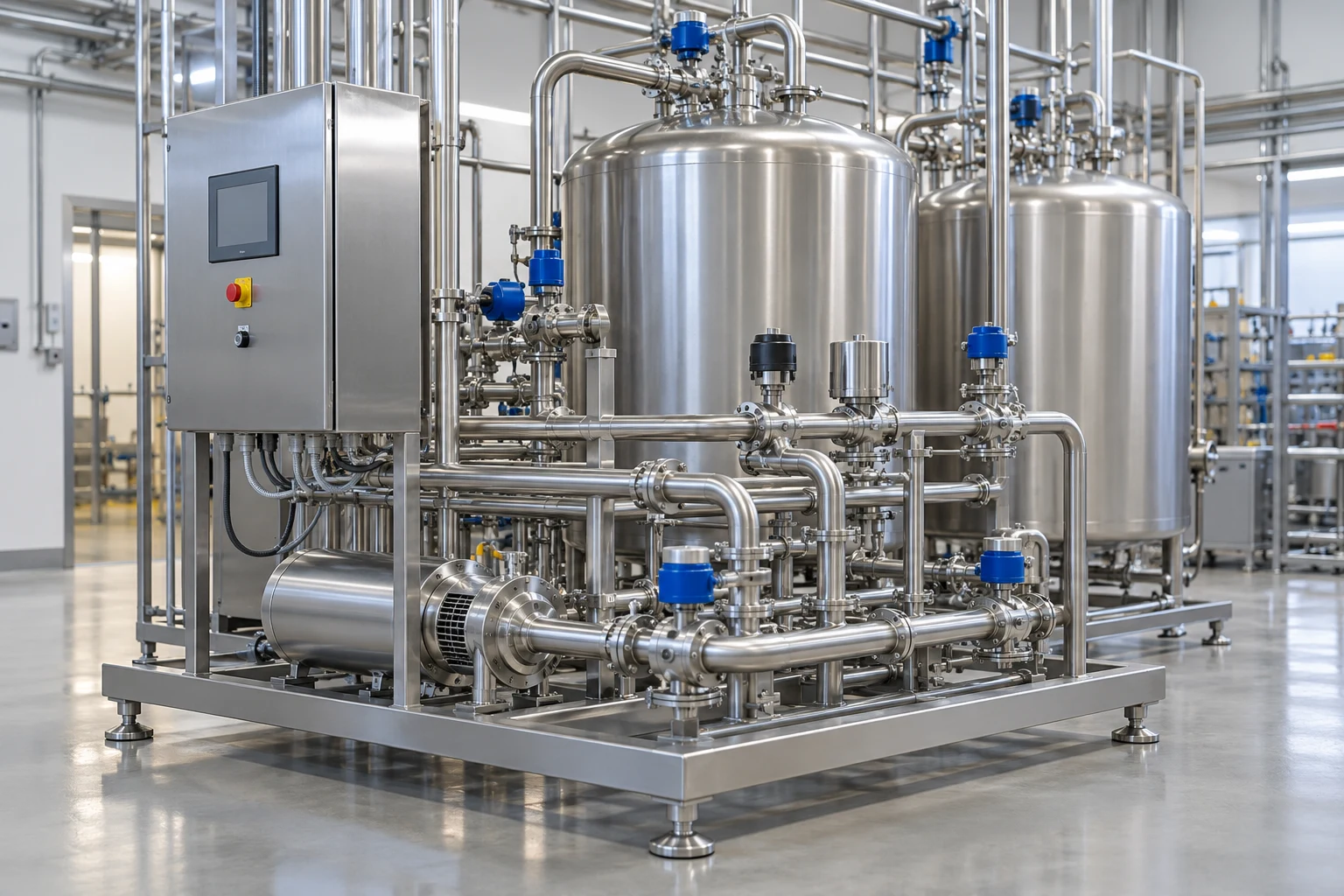
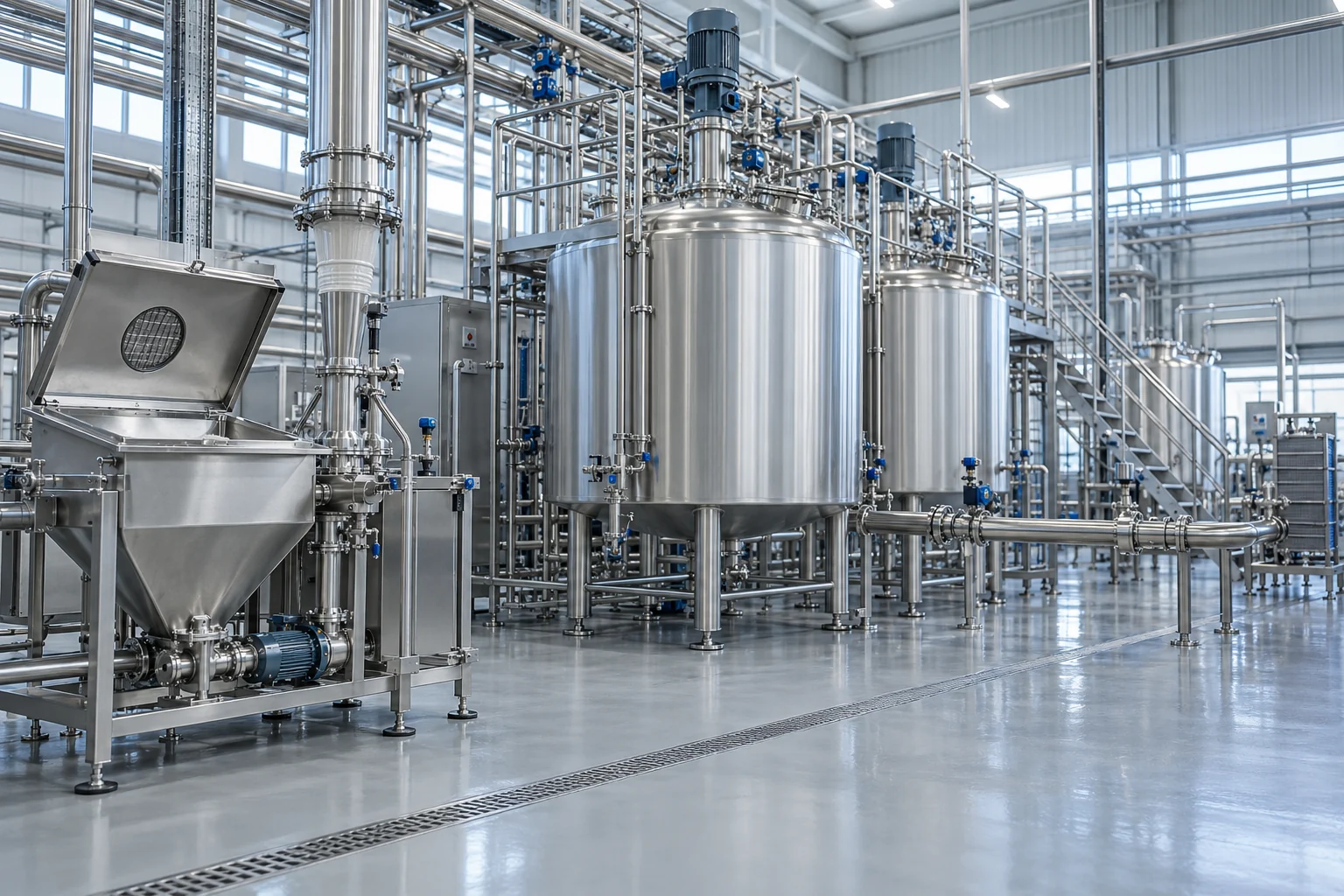
Beverage preparation tanks and connected mixing process equipment
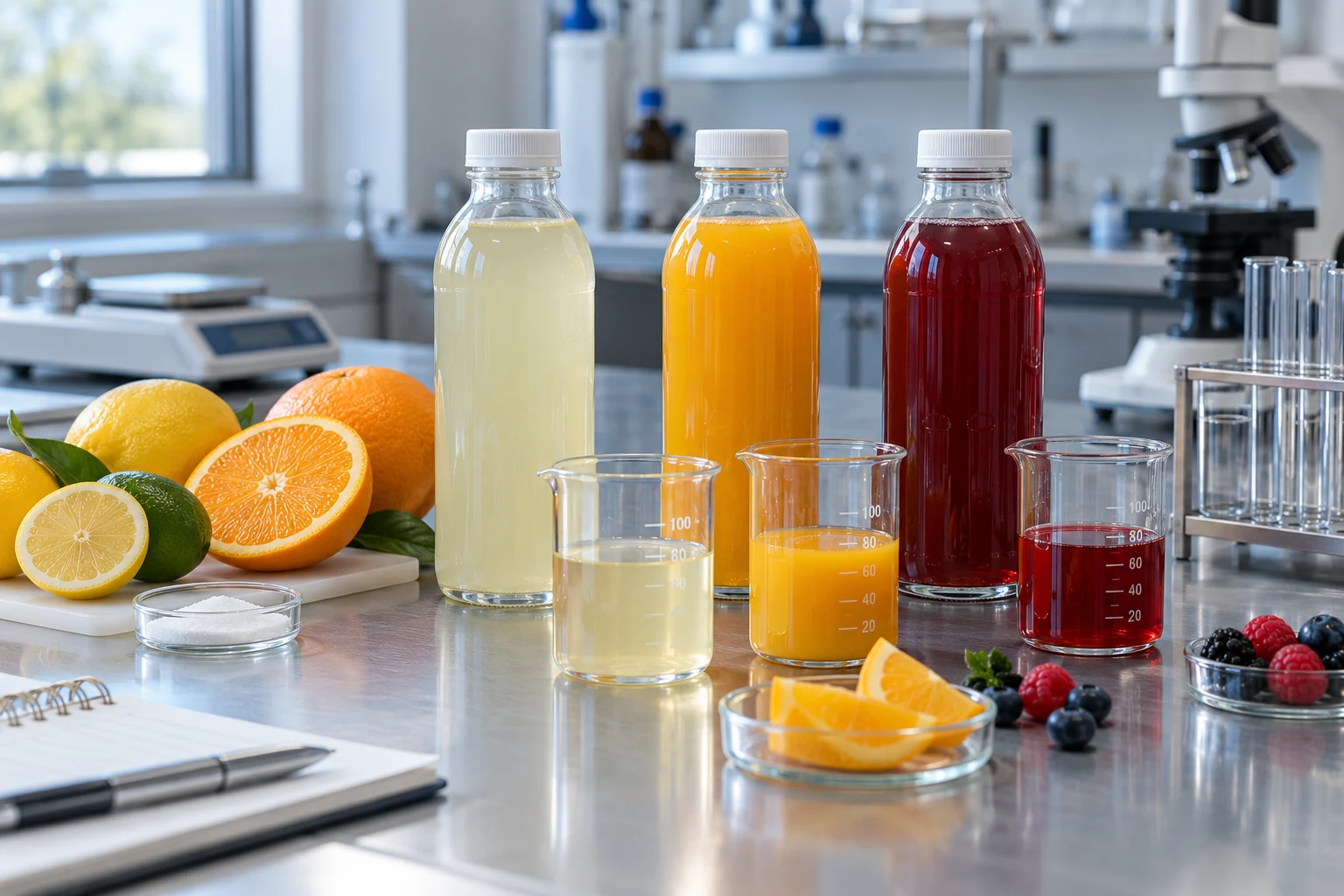
Unbranded functional beverage and juice samples with ingredient context

Juice & Functional Beverage Production Requirements and Product Variants.

Vitamin, Mineral and Electrolyte Drinks

Define ingredient solubility, small-dose accuracy, addition order and the required concentration evidence. Review whether pre-dissolution, measurement or control reduces the actual deviation rather than simply increasing mixer speed.

Fiber, Emulsion and Botanical Systems

Powder wetting, hydration, viscosity, entrained air and ingredient sensitivity can change through the process. Trial representative recipes through treatment and package evaluation with qualified specialists.

Juices, Nectars and Fruit-Based Functional Drinks

Specify pulp / particles, acidity, color, treatment and the package / storage objective. Juice solids and functional additions may create different transfer, mixing and cleaning limits from a clear electrolyte drink.

Connect the Production Process

Separate dosing errors, wetting / hydration time, recirculation and quality-release waits before replacing the mixer.

  1. Characterize ingredientsSolubility, sensitivity and addition order.
  2. Record batching stepsActual time, additions and rework.
  3. Trial the proposed dutyMixing, uniformity and entrained air.
  4. Test the full recipeTreatment, package and qualified release.
Resolve before procurementA mixer can shorten dispersion while a separate hydration residence or filler bottleneck remains.

Build the complete product and package route before changing line rate or buffer capacity.

  1. Define product envelopePulp, solids and storage objective.
  2. Assign preservation scopeQualified process / package specialists.
  3. Balance transfersApproved holding and filler access.
  4. Verify good packagesQuality and actual shipped volume.
Resolve before procurementDo not infer shelf stability from acidity, a hot fill or one universal temperature.

Map ingredient identity, dose confirmation, recipe authority, process states and qualified product transitions.

  1. Govern recipesApproved versions and permissions.
  2. Control additionsMeasurements and exception handling.
  3. Coordinate CIPActual circuits and utility duty.
  4. Restart consistentlyFirst good product and batch evidence.
Resolve before procurementAutomation supports the agreed procedure; it does not approve the formula or the cleaning process.

Equipment & Integration Scope

Review each system by its operating duty and the interfaces to be agreed before procurement.

System Duties & Engineering Questions

Equipment Duties, Utilities and Supplier Responsibilities.

Swipe horizontally to compare all columns ↔

Select by operating duty and agreed supplier scope
SystemOperating dutyRelevant DPS guideConfirm before purchase
Configured tanks / vesselsIngredient staging, blending and qualified buffer duty.DPS tanks & vessels ↗Working volume, mixing, hydration and permitted holding.
Recipe / sequence controlsIngredient dosing / recipe and filler handshakes.Automation & controls ↗Version authority, alarms, out-of-sequence handling and records.
CIP equipment and circuit interfacesProduct-soil and flavor / allergen transition circuits.DPS CIP systems ↗Qualified release, return conditions and shared utilities.
Specialist equipment interfacesSelected mixer, treatment and filler specialist packages.Installation & integration ↗Actual recipe / package trials and OEM acceptance boundary.

Functional Beverage Mixing System Upgrades: Match the Symptom to the Investment.

Searches such as “functional beverage production line upgrade,” “powder mixing system upgrade” and “beverage dosing accuracy problems” describe different buying questions. Begin with the loss mechanism. The table below separates formulation / ingredient work from equipment, controls and complete-line integration; a larger mixer is only one possible intervention.

Swipe horizontally to compare all columns ↔

Functional drink production problems and evidence-led engineering scope
Observed production problemEvidence to collectPotential project scope
Powder fisheyes / incomplete hydrationIngredient, addition order, wetting / hydration time and qualified uniformity samples.Trial induction, recirculation, mixing duty and operating sequence with ingredient specialists.
Batch concentration variesDosing checks, actual ingredient identity, measurement and approved recipe version.Measurement / dosing and recipe-management controls with exception tests.
Mixer is fast but filler waitsBatch-ready, treatment / hold, transfer and filler-state timestamps by SKU.Line balance, product-approved buffers and OEM process / filler handshakes.
Flavor / allergen transition consumes the shiftFull qualified cleaning, verification, setup and first-good-product timeline.Installed CIP / route / recipe interface correction without weakening release requirements.
New ingredient loses stability after scale-upQualified samples through actual treatment, package and storage evaluation.Product / ingredient / specialist process trials before equipment commitments.

Engineering the Whole Line

Start with the business outcome

A functional beverage owner may search for a mixing-system upgrade because production is slow, powders form lumps, micro-ingredients vary or the filler repeatedly waits. DPS can connect those symptoms to process engineering, configured batching / transfer equipment, utilities, recipe controls, CIP and specialist treatment / filling interfaces. The project should protect the qualified formula while proving useful output and a transparent installed-cost / ROI case.

Functional-ingredient efficacy, nutritional claims, formulation stability, heat / oxygen sensitivity and product / package release belong to qualified ingredient, product and process specialists. A generic mixer specification cannot establish a functional claim or shelf life. This page covers juice / functional liquid processing; high-protein shakes have a separate protein-RTD guide.

Commissioning Tests and Performance Acceptance.

Agree Ingredient and Product Requirements

Define solubility, small-dose accuracy, addition order, pulp or particles and the intended treatment, package and storage route.

Trial Hydration and Dosing

Check representative powders, fibers, emulsions or botanical ingredients through the agreed preparation and treatment sequence with qualified specialists.

Verify the Complete Campaign

Confirm dose identity, blend uniformity, transfer and filler readiness, qualified flavor changes and accepted packaged output.

Sanitary clean-in-place skid, tanks and supply-return piping

Plan Your Project

Review the scope, cost assumptions and operating case for your project. The examples and calculators below support early planning and are not DPS quotations.

Compare Operating Corrections, Retrofit and Replacement.

Collect batch / dosing records, powder and formulation behavior, treatment holds, filler states and actual transition losses. Trial the worst-case recipes before committing to a mixer or automation package.

Investment boundaryThe default links useful released time to sold volume and separately verified baseline material savings; new-volume ingredients and production labor are already in variable cost.

Fix the ingredient / claim / package envelope, qualified preservation route, specialist trials, operating schedule and demand before layout. Coordinate water, powder handling, mixing, treatment, filling, CIP and utilities.

Investment boundaryInclude full specialist equipment / integration, site, fixed payroll / overhead, launch cash and working capital. Historic plant savings do not exist in a new operation.

Powder Lumps or Long Hydration, Micro-Ingredient Variation and Operating Value.

Swipe horizontally to compare all columns ↔

Value-driver and responsibility map
Observed conditionMeasure before designDPS / team decisionEconomic basis
Powder lumps or long hydrationAddition sequence, batch times and accepted uniformity.Trial induction / mixing / temperature and ingredient handling.Useful recovered capacity at contribution after downstream / demand limits.
Micro-ingredient variationActual dose, identity and recipe version evidence.Improve measurement, permissives and traceable additions.Verified baseline purchase / reject costs, without invented compliance savings.
Blend-ready filler waitsReady / starved / blocked states across recipe and package.Balance batching, transfer and specialist package interfaces.Incremental accepted sold output, not blend-tank nameplate.
Long qualified flavor changesDrain, cleaning, release and first-good-product timestamps.Review circuits, sequence and resource measurements.Independent resource reductions and realized usable time.

Choose the Functional-Drink Upgrade Scope

Swipe horizontally to compare all columns ↔

Project Scope Comparison
DecisionTargeted WorkBroader Scope
Ingredient PreparationTrial addition order, pre-dissolution and existing mixing duty.Reconfigure induction or preparation after identifying the limiting ingredient behavior.
Micro-DosingImprove measurement, permissives and recipe records.Integrate additional dosing equipment with verified batch identity.
Filler ReadinessBalance ready batches, transfer and qualified changeovers.Expand the limiting process or package stage on matched line-state evidence.

Juice & Functional Beverage Equipment Price vs Full Installed Project Cost.

Compare proposals with the same product duty, supplier boundaries and acceptance basis. The amount below is a transparent planning example, not a market price range, supplier estimate or DPS quotation.

Illustrative scope-based budget / USD
Cost bucketAssumed amount
Product / process and interface engineering$47,000
Defined configured / OEM component allowance$164,000
Mechanical / electrical field installation$90,000
Instrumentation and control integration$47,000
Commissioning and acceptance support$27,000
Training, documentation and closeout$15,000
Defined project scope$390,000
Separate site / facility additions$50,000
Capital contingency (15%)$66,000
Separate one-time startup / shutdown cost$35,000
Incremental working capital$30,000
Total initial cash$571,000

The defined scope assumes applicable freight, procurement charges and taxes are included in the owner’s estimate. Add missing civil, land / shell, OEM, environmental, validation and permitting costs explicitly. Site and field conditions, duty, production access and quoted supplier scope determine actual price. Financing is excluded.

Worked Operating Case

Hypothetical owner-budget case: 250 days × 0.75 useful recovered hour/day × 1,000 good kg/h × 65% realization gives 121,875 incremental sold kg/year after the 150,000 kg demand ceiling. Net price $4.4/kg less incremental variable cost $2.7/kg gives $1.7/kg contribution. The baseline inputs assume $12,000 energy, $18,000 water / chemistry and $7,000 maintenance reductions per year. Avoided payroll is 300 hours × $40 × 50% cash realization. Verified baseline purchase reduction contributes $6,720; its basis is unchanged accepted baseline output. Deduct $22,000 added annual fixed cost. Result: $234,907.5 steady net benefit; initial cash $571,000 includes the separate site, contingency, startup and working-capital inputs. These are original illustrative assumptions, not a quotation, price benchmark or achieved DPS result.

Calculated from these assumptions: steady annual net benefit $234,908; year-one net cash $157,835; cash payback 2.76 years; five-year NPV at 10% is $249,419. Change the assumptions below to test a different case.
Juice & Functional Beverage Upgrade ROI, Payback and Cash Flow.

Replace the illustrative inputs with your own measured or quoted values. The five-year pre-tax model uses good kilograms, demand-capped contribution and separately verified baseline savings; it is not a project quotation.

USD / 5-year screening model / pre-tax, unlevered

Juice & Functional Beverage Engineering and Investment Retrofit Example

All defaults are illustrative. The default case is an operating-plant improvement, not a greenfield quote. For a new operation, set baseline savings to zero and enter every additional operating and capital cost.

All-in Investment & Working Capital

Calendar & Constrained Good-Output Rate

Verified Baseline Savings & Added Operating Cost

Ramp, Discount & Target Payback

Initial cash investment
$571.0k

Includes contingency, startup and working capital

Steady annual net benefit
$234.9k

Incremental operating cash before tax

Cash payback
2.76 years

Includes year-one ramp assumption

5-year NPV
$249.4k

At 10% annual discount

Steady annual cash ROI
41.1%

Net annual benefit ÷ initial cash

5-year net cash ROI
92.2%

Net cumulative gain ÷ initial cash

Modeled incremental sales: 121,875 kg/year at $1.70/kg contribution. The base case has a nonnegative five-year NPV at the selected discount rate. Year-one net cash: $157,835.

Realization needed for the target operating payback

29.9%

Minimum capacity realization for a 5-year operating cash payback; terminal recovery excluded. Demand and unit margin must also hold.

CSV export is local. No inputs are submitted.

Cumulative Project Cash

BaseDownside

Swipe the chart to compare all five years ↔

Five-year cumulative project cashBase case starts at −$571,000 and ends at $526,465. Downside ends at $35,753. Annual values are available in the table below.−$768.1k−$296.6k$174.9k$646.3k0Initial: −$571,000InitialYear 1: −$413,165Year 1Year 2: −$178,257Year 2Year 3: $56,650Year 3Year 4: $291,558Year 4Year 5: $526,465Year 5
Undiscounted cumulative cash. NPV separately discounts year-end flows; working-capital recovery defaults to zero.

Inspect Annual Cash Flow and Sensitivity

Swipe horizontally to compare all columns ↔

Base-case cash flows
YearNet cashCumulative cashDiscounted cash
Initial−$571,000−$571,000−$571,000
Year 1$157,835−$413,165$143,487
Year 2$234,908−$178,257$194,138
Year 3$234,908$56,650$176,489
Year 4$234,908$291,558$160,445
Year 5$234,908$526,465$145,859

Swipe horizontally to compare all columns ↔

Sensitivity assumptions are not forecasts
CaseAnnual benefitNPVCash payback
Downside$152,033−$143,3414.76 years
Base$234,908$249,4192.76 years
Upside$289,812$442,5772.29 years

Downside: installed and site costs +20%, realization ×0.75 and unit contribution reduced by 20% of its absolute value. Upside: realization ×1.15, capped at 100%, and unit contribution improved by 10% of its absolute value. The demand ceiling still applies.

Calculation Basis

  • Five-year, pre-tax cash flow. Financing, depreciation and asset resale are excluded.
  • Initial cash includes contingency, startup costs and working capital; year one reflects ramp-up.
  • Output is capped by demand. Count each production gain or verified cash saving once.

Functional Beverage Ingredient-Purchase Saving Calculation

Defaults match the main material input: 800,000 − 796,800 = 3,200 kg actual baseline purchases avoided × $2.10 = $6,720/year. Compare unchanged accepted good output / product mix. Incremental output already valued in contribution is excluded; added annual trial expense belongs in the main fixed-cost allowance.

Enable JavaScript

Prepare a Juice & Functional Beverage Equipment / Upgrade Brief.

Prepare the information below, export the assumptions you have modeled, and discuss the unknowns with DPS. An unmeasured input is a question to resolve, not a reason to invent precision.

Discuss this project ↗

Checklist and model data stay in this browser until you choose to share them.

Juice & Functional Beverage Equipment and Plant Upgrade FAQ.

How do I choose equipment for a functional beverage line upgrade?
Start with the specific ingredient / dosing / hydration or line-state problem, the qualified recipe / package envelope and matched baseline. Compare a tested correction with replacement on all-in scope and accepted output.
Will high shear fix every powder-mixing problem?
No. Wetting, addition order, ingredient hydration, viscosity, air and sensitivity can be different limitations. Trial the actual formula and verify the entire process rather than specifying more shear by default.
Does a functional drink have the same processing requirements as juice?
No. They can share equipment categories but differ in particles, ingredient sensitivity, dosing, stability and preservation / package basis. Define compatible product families and separate duties where needed.
Are these prices or returns a DPS commitment?
No. The example inputs exist to make the business-case calculation reviewable. Actual scope, prices, schedule, savings and performance need project-specific assessment and agreement.
What should the first DPS conversation include?
Bring the product and package mix, operating baseline, commercial target, retained assets, site constraints, available outage window and the capital options you are considering. Mark unknowns for measurement or supplier trials.

Discuss Your Juice & Functional Beverages Project

Bring your product requirements, operating priorities and site constraints to an initial scope discussion with DPS.