In This Article
QUICK ANSWER
How Should a Ready Meal Factory Be Designed as One System?
Define the product and its required process first, then connect cooking, component handling, assembly, cooling, packing and distribution through a timed operating model. A cooker quotation cannot establish factory capacity. The receiving operation, permitted product conditions, packaging route and released storage must support the same production program.
For ready meal factory design, compare alternatives by the saleable meals they can deliver through that complete route. Establish the relevant food-safety basis with the responsible specialists before treating an arithmetic buffer or a longer holding period as a practical capacity solution.
Ready meals combine operations that often run at different rhythms. Cooking may release a batch; assembly consumes portions continuously; cooling occupies space over time; orders leave in a different pattern again. A well-sized individual machine can still wait because another stage cannot receive its output.
The investment challenge is to identify that dependency before the factory is built. It also matters during expansion, when an available corner of the building can tempt a team to add capacity upstream without changing the route that receives it. DPS's cooking-vessel offering and process-to-field integration services can support defined equipment and interface decisions, while the product's actual thermal and food-safety requirements remain part of the project-specific design basis.
1. Define the Actual Meal Route Before Drawing Rooms
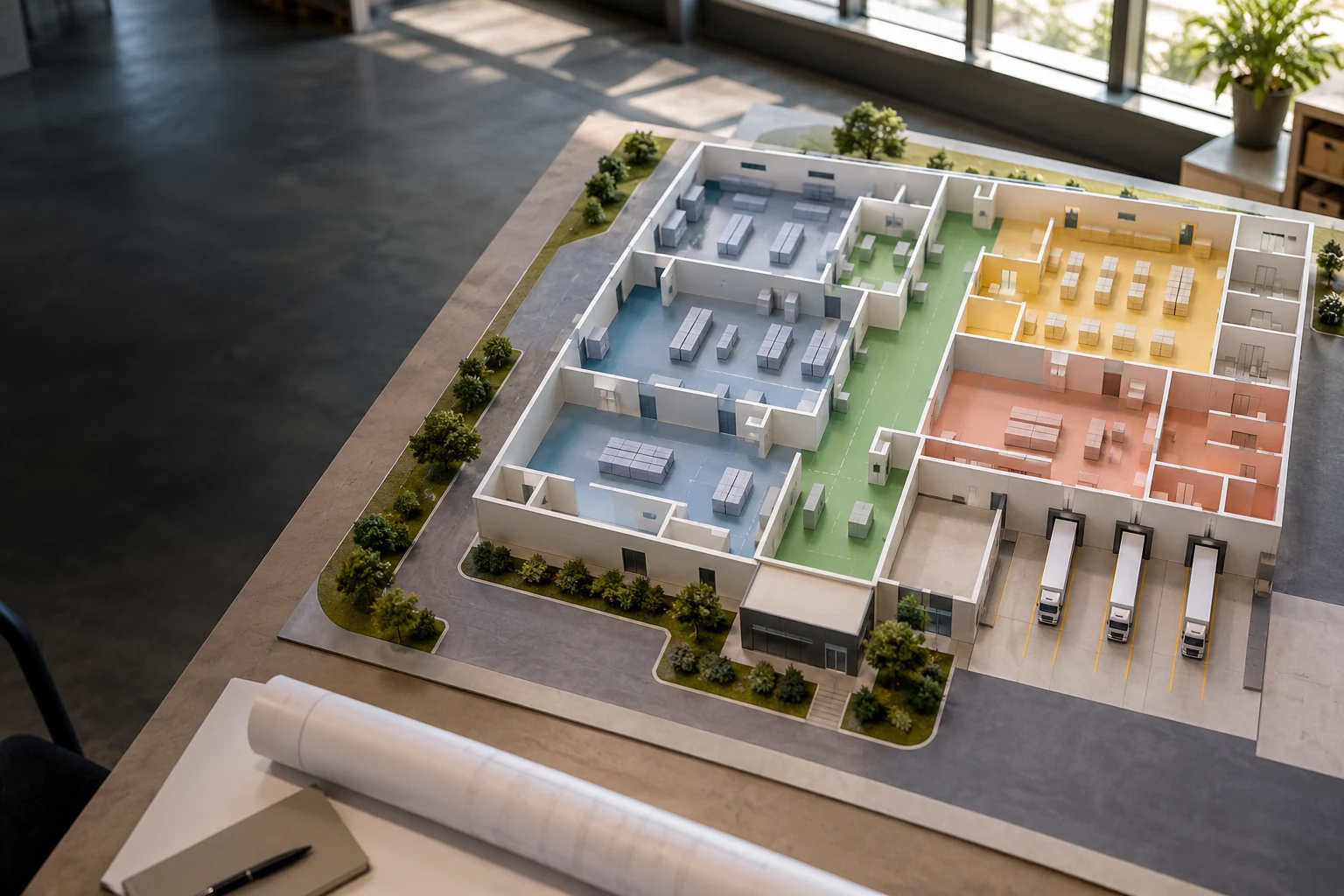
A ready meal is a commercial category, not one universal manufacturing process. Establish which components arrive raw, cooked, chilled or frozen; which are processed on site; and how the final product is packed, stored and used. Those decisions determine the operations the building must accommodate.
Record the intended product families and pack sizes alongside their process routes. Two meals can look similar on the shelf while using different component preparation, assembly or cooling arrangements. Designing around a generic product arrow can hide the point where those routes diverge.
Use the product-specific hazard analysis and process requirements to establish separation, conditions and permitted movement. The layout should follow that operating basis rather than using an attractive room plan to decide how food will be handled afterward. Regulatory applicability depends on the actual product and establishment; a mixed product portfolio needs deliberate review.
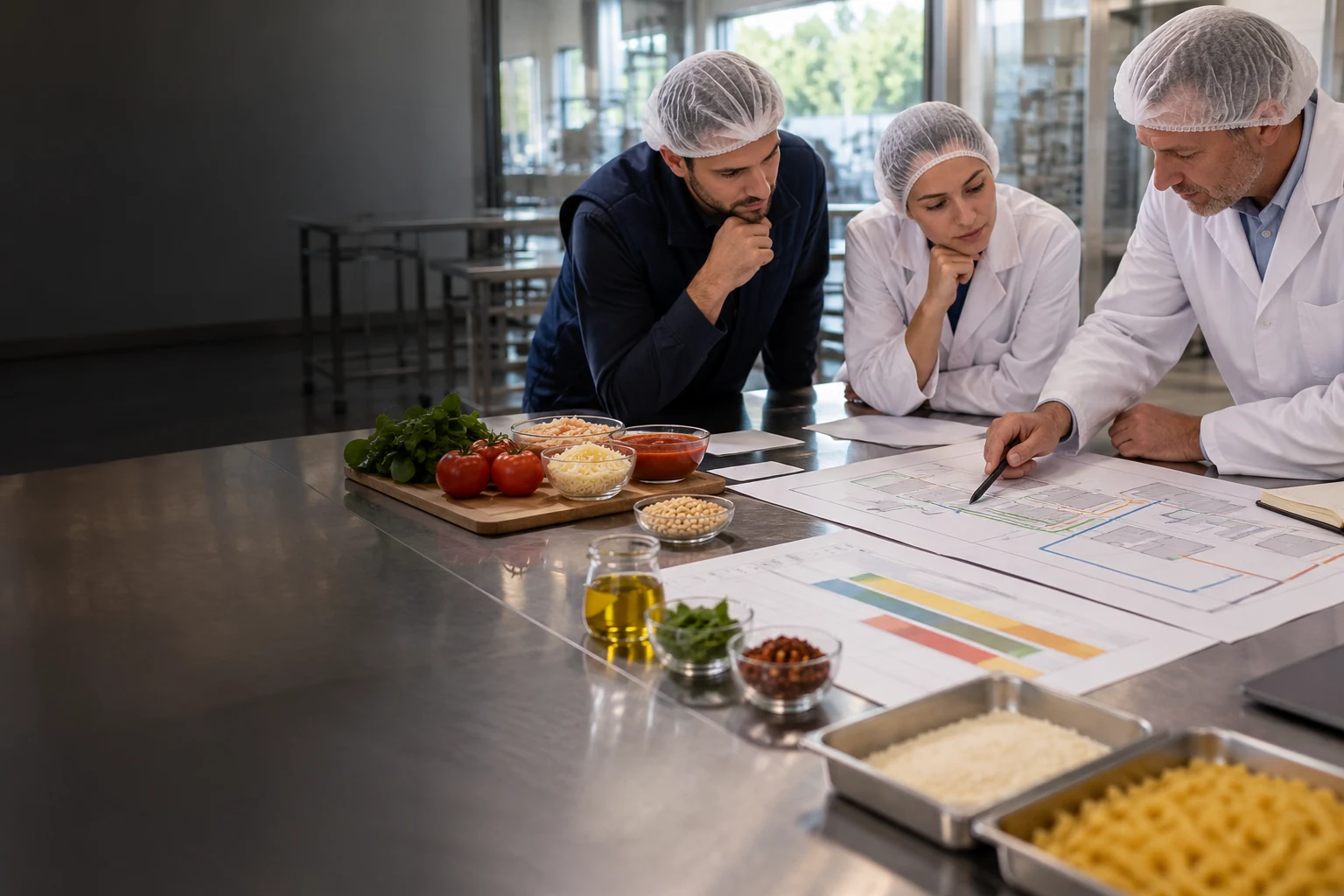
A DPS process-engineering engagement can translate the defined routes into flow diagrams, equipment documentation, layout, utility requirements and controls interfaces. Ask for the decision that each room or connection supports, rather than a collection of disconnected drawings.
Begin with a representative meal and then test the exceptions that matter commercially. A different component, allergen profile, package or distribution condition may require a separate route or a changed operating sequence. Identify those changes while the building remains flexible, before a supposedly shared area becomes the constraint on the product range.
2. Specify Cooking Around Formulation and the Receiving Operation
A cooking package needs a defined product duty. Formulation, viscosity, particles, agitation needs and transfer behavior influence how a batch can be prepared and discharged. The required thermal process must be established by the appropriate specialists; a general planning article should not substitute a universal temperature or cooking time.
DPS's kettles and cookers offering connects cooking vessels with agitation, steam and condensate, CIP, transfer and recipe controls. For a ready-meal project, this makes the discharge destination an essential part of the equipment brief. Ask how the prepared component reaches the next approved operation without relying on an undefined temporary holding arrangement.
Consider the complete occupancy of the cooker: loading, processing, transfer and the required turnaround. A short heating stage does not necessarily create a short batch cycle. If discharge must wait for portioning or another component, the vessel remains unavailable for the next batch.
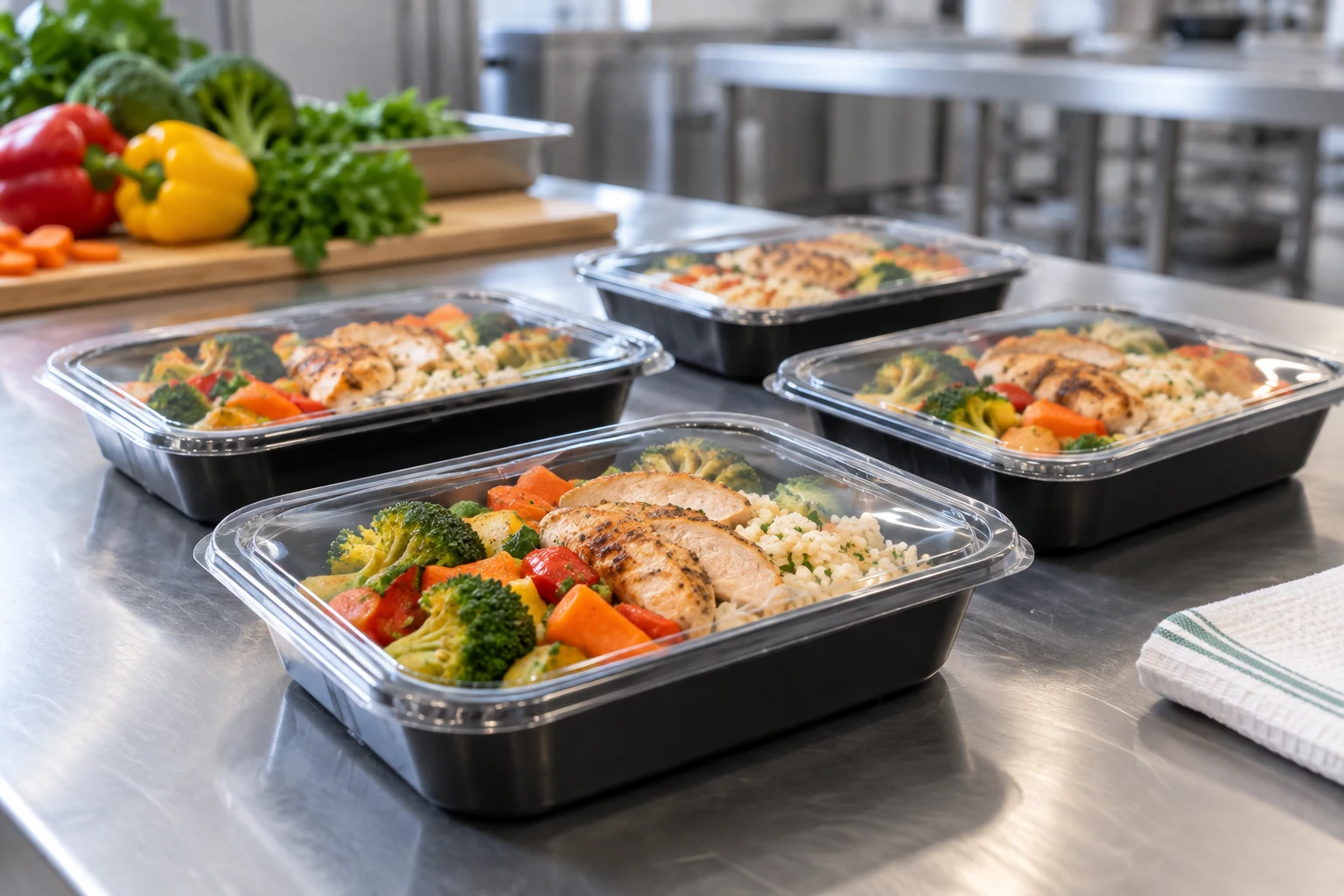
The supplier enquiry should define usable batch quantity, product conditions at the handoff, destination readiness and the cleaning boundary. Include the control response when the destination stops. These interfaces explain whether an additional cooker would create output or merely more waiting product.
Ask operations to walk through a product transition. The transition often reveals shared labor, ingredient or receiving limitations that are absent from the steady-run equipment rating. For example, two components might need the same transfer resource during assembly replenishment. State whether their releases can be staggered within the product requirements before crediting both cookers with independent output.
3. Expose the Assembly Mismatch with a Portion Balance
Use common units to connect batch production with assembly. Convert the cooked component quantity into the portions the intended recipe and package require. Then place those arrivals against the downstream receiving calendar. The calculation should expose accumulation, not assume that accumulated food can wait without a defined process.
In an invented four-hour example, an upstream operation supplies 1,000 portions per hour while the receiving assembly operation handles 800. Arrivals total 4,000; assembly completes 3,200 during the same window. The arithmetic backlog reaches 800 portions and would need another hour at 800 per hour after arrivals stop.
| Quantity | Calculation | Result |
|---|---|---|
| Arrivals | 1,000 × 4 h | 4,000 portions |
| Assembly during window | 800 × 4 h | 3,200 portions |
| Unprocessed balance | 4,000 − 3,200 | 800 portions |
| Arithmetic clearance | 800 ÷ 800/h | 1 h |
Before accepting that scenario, establish whether the proposed product conditions, residence and handling are permitted and supported. If they are not, the backlog is evidence of an infeasible plan, not a reason to buy a larger holding container.
Illustrative four-hour portion balance
Arrivals · 4,000
Assembled · 3,200
Unprocessed · 800
The capital choice is now clearer: rebalance upstream release, improve the receiving stage or change the campaign within the approved process. Increasing cooking capacity alone intensifies the mismatch. Check each component separately; one missing item can stop complete-meal assembly even when total food mass appears adequate.
Keep the balance attached to the recipe issue used for design. A changed portion size alters the number of finished meals supported by each batch. Review the limiting component at the same time: an excess of sauce cannot compensate for a shortage of the specified protein portion. The investment model should report complete meals, with component imbalances visible alongside the total.
4. Define Cooling as a Supported Process Duty
Cooling is not simply available refrigerated floor space. The relevant product, load geometry, incoming conditions, packaging state and permitted cooling process determine the duty that must be demonstrated. Equipment selection and loading arrangements should follow that basis.
For applicable heat-treated meat and poultry products, FSIS's stabilization guidance addresses limiting pathogen growth and the scientific support for the process. It is guidance for its stated scope, not a universal cooling recipe for every ready meal. The project team must establish the applicable product and process requirements.
Place the actual cooling occupancy into the operating calendar. A batch entering the cooling route consumes positions until it can move to the next defined state. If loading, unloading or the receiving store is delayed, those positions remain occupied and can prevent the next cooking release.
Review the handoff between process design and refrigeration design. Product quantity alone is insufficient: the refrigeration specialist needs the defined product duty and operating pattern. Equally, available refrigeration power does not prove that the load arrangement achieves the required product condition.
Specify the evidence for the intended production scenario before purchase. Include the product and loading basis, measurement responsibilities and treatment of an unsuccessful result. This makes the comparison about supported process capability rather than an advertised cooling time taken from unrelated conditions.
Keep any waiting or temporary route inside the same reviewed process. A queue that appears convenient in a capacity model must not become an unexamined operating practice.
5. Compare More Cooking Capacity vs a Balanced Downstream Route
When the plant misses output, the visible cooking operation can attract the next capital request. Test that request against the connected calendar. If the cooker waits for assembly, cooling or a transfer route, another cooker may add cost without removing the limiting condition.
| Option | Useful When | Evidence Required |
|---|---|---|
| Add cooking capacity | Required prepared components arrive too late | Receiving operations can accept the extra release |
| Improve assembly or handling | Prepared components accumulate before portioning | Balanced component arrivals and pack calendar |
| Expand cooling route | Supported cooling occupancy limits release | Product-specific duty and receiving storage |
Evaluate the full installed scope of the preferred route. Equipment, product transfer, services, controls and building connections belong together. A cheaper machine can require a more expensive receiving or handling arrangement than the alternative.
Product variety matters as much as maximum rate. An arrangement that performs well on one long campaign may lose its advantage when several short recipes require different components and changeovers. Compare a representative commercial week, including the meal combinations that operations must actually make.
Follow people and packaging materials through the proposed layout as well as product. Assembly can be limited by replenishment or removal even when portioning machinery has adequate nominal speed. Those movement problems need a layout response, not a higher cooker rating.
The owner should see the mechanism behind the recommendation: which waiting condition disappears, how the next stage receives the product and which operating constraints remain. That explanation is more useful than a broad claim that the line has been optimized. Ask suppliers to identify the trial condition under which their package can demonstrate the claimed contribution. A result obtained with another component, pack or receiving arrangement may not answer this project's actual constraint.
6. Release Useful Operating Areas without Confusing Project Milestones
This is a staged-execution analogy, not a ready-meal thermal-validation case. The useful distinction is between a defined area becoming operable and the complete project achieving its final integrated state. A ready-meal expansion can use that distinction to structure commissioning without claiming that every connected product route is ready at once.
Identify which bounded operation can be checked and released independently. Component preparation, assembly and cooling may each depend on shared services or another area's availability. A release milestone should state the permitted operating scope and prerequisites so an early achievement is not mistaken for acceptance of the whole factory.
For an operating-site project, DPS's general-contracting service connects process-critical installation, piping, controls and commissioning with specialist building trades. Ask the execution team to schedule work around those dependencies and the production windows the owner can actually provide.
Do not let the construction sequence define the food process by accident. Before an area runs, the responsible team must establish its relevant process, sanitation, operating and release requirements. A convenient temporary connection is not automatically an approved production route.
The investment advantage is earlier visibility into usable functions and unresolved interfaces. It does not require labeling an unfinished integrated line as full-capacity production.
7. Connect Packaging and Distribution to Released Output
Finished meals become useful inventory only when they meet the defined release conditions and can move through the intended distribution route. Distinguish packaged units, held units and released saleable units in the production model. Treating all three as equivalent can overstate capacity and understate storage needs.
Build a daily inventory profile using production completion, release and dispatch timing. The peak can occur before the last production run ends or while a particular lot remains on hold. The layout needs a practical place and identification method for each relevant status, consistent with the facility's actual requirements.
Packaging format affects the downstream plan. Trays, cases and shipping units change handling, storage occupancy and order assembly. Confirm which unit each supplier uses when quoting line capacity or storage positions, and use the actual recipe portions when converting between them.
Review movement from cooling to packing or storage according to the chosen process. The sequence differs by product and packaging strategy; do not impose one route on every meal. The process documents and layout should show the selected route clearly enough that commissioning can follow it.
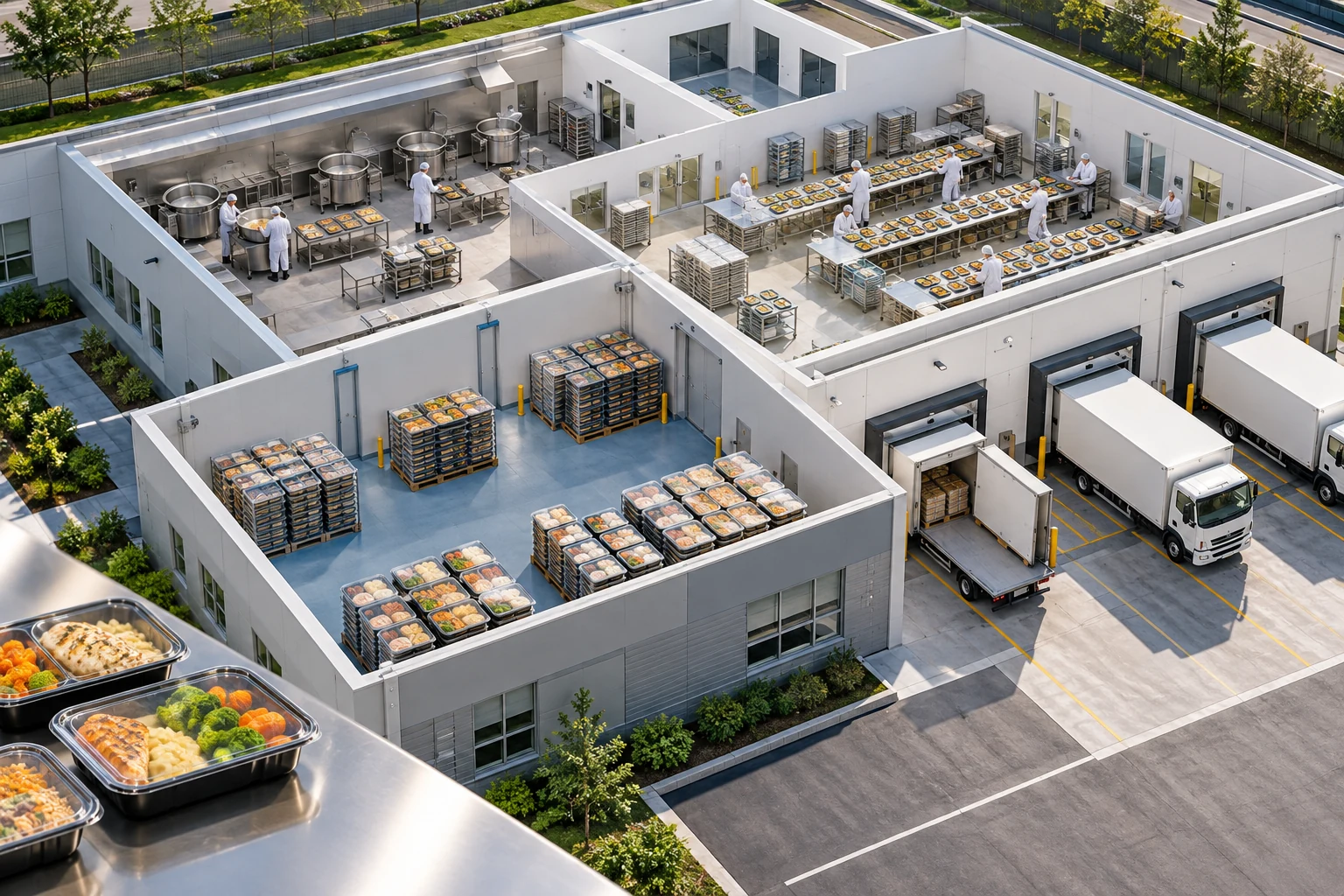
Test the busiest dispatch period against normal production. An aisle that works while shipping is idle may fail when orders are assembled. Protect the handoff to distribution while selecting process equipment so the final investment supports delivered meals, not merely completed batches.
8. Approve an Investment Brief That Follows One Complete Meal
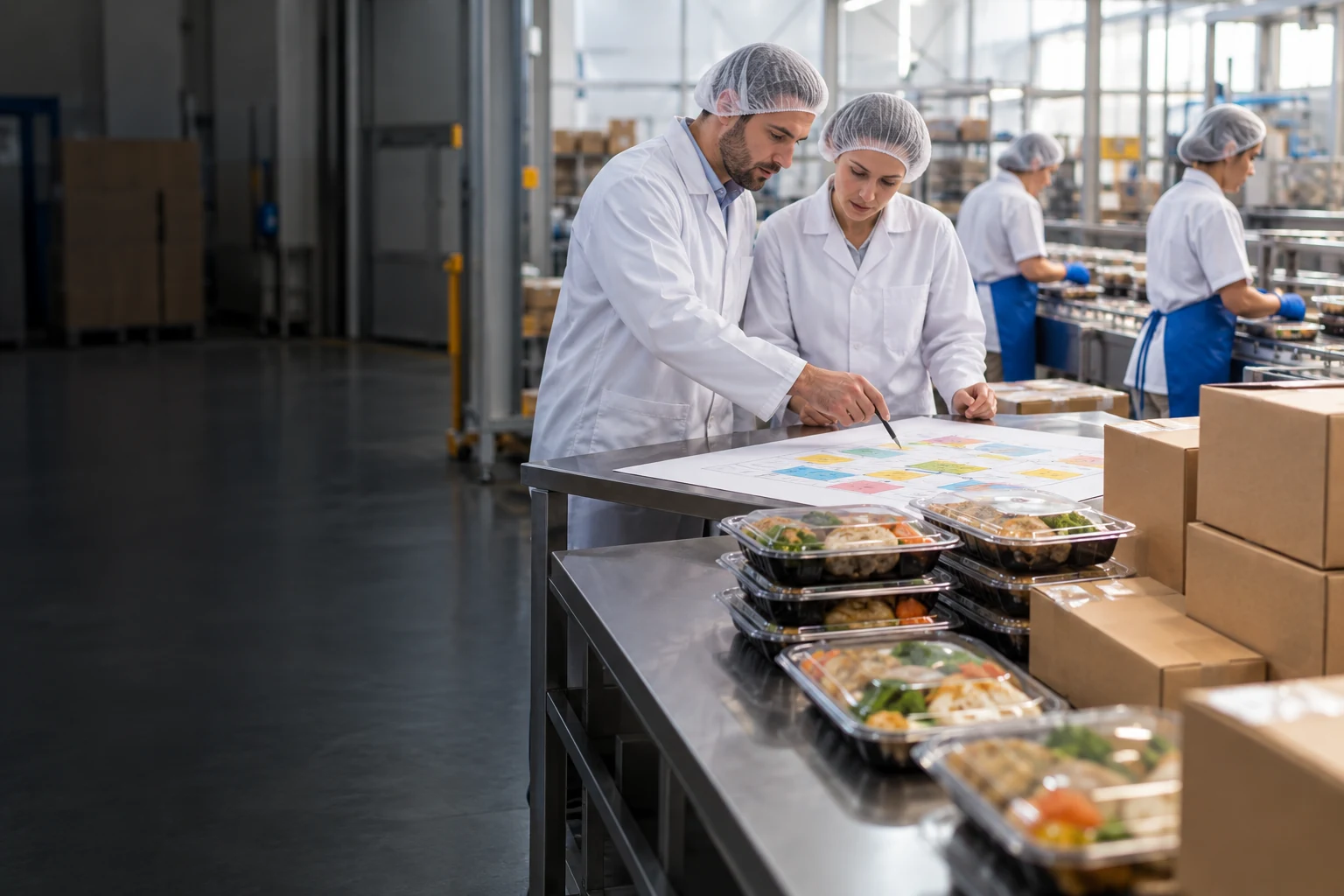
Use a representative meal to connect the design deliverables. Follow its ingredients through preparation, cooking, component release, assembly, cooling, packing and dispatch as applicable. At each handoff, state the quantity, timing, product condition, receiving requirement and responsible package.
This brief gives DPS and specialist suppliers a shared basis for engineering and quotation. The cooker enquiry can refer to a defined receiving duty. The building team can design the required rooms and services around actual operations. The controls narrative can explain what happens when the next operation cannot accept product.
Compare options against the same meal program and operating calendar. Separate the benefit of higher rate from the benefit of greater recipe flexibility or reduced dependence on a shared asset. Those are different commercial outcomes and may justify different investments.
Include the evidence needed to progress from design assumptions to accepted operation. Identify product trials, supplier data, commissioning checks and the applicable process verification responsibilities. Unresolved product decisions should have a visible effect on procurement release rather than remaining buried in a general allowance.
For a new build, preserve access and connection points for the most credible next constraint. For an expansion, price the required interruptions and temporary states alongside the equipment. Both routes need a clear integrated startup plan.
The final approval should explain why the selected scope delivers the planned meals through the approved route. That causal chain is the foundation for a factory that can be operated, verified and expanded with confidence.
Ready Meal Factory Design FAQ
Should the cooker be selected before the layout?
Define the product route and duty first, then develop equipment and layout together. Receiving, transfer, cleaning and utility interfaces can materially change the appropriate cooking package.
Can a buffer solve an assembly bottleneck?
Only if the product's permitted conditions and residence support that route. A calculated backlog is a capacity warning, not permission to hold food. Rebalance the process if the proposed waiting condition is unsuitable.
Does one cooling rule apply to every ready meal?
No. Establish the applicable product and process basis with the responsible specialists. Meat and poultry guidance has a defined scope and should not be treated as a universal recipe.
When is another cooker justified?
When cooking or component availability is the verified constraint and downstream operations can receive the added output. Include complete batch occupancy and the commercial product calendar.
Can part of a new line start before final project handover?
A defined operating area may be released against its applicable prerequisites. Clearly distinguish that bounded release from complete integrated performance acceptance and final project closeout.
What should the initial DPS brief include?
Provide product families, process routes, portion and packaging requirements, operating calendar and known site constraints. Request a connected equipment, layout, utility and execution basis rather than an isolated cooker price.
Sources and Calculation Notes
DPS services, equipment and project statements use the sources below. Numerical examples are original teaching calculations, not customer results, supplier quotations or sizing recommendations.
- DPS — Process Engineering & Design. Process documents, utility loads and equipment interfaces.
- DPS — General Contracting. Coordinated field execution and delivery responsibilities.
- DPS — Kettles & Cookers. Current cooking-vessel offering and interfaces.
- DPS published project — Ground Beef Line Execution — Confidential Client. Project-specific account, attributed to DPS.
- USDA FSIS — Stabilization Guideline, Revised Appendix B. Heat-treated meat and poultry stabilization requires applicable scientific support; not a universal cooling recipe for all ready meals.
Research reviewed October 27, 2026.