Fresh / White Cheese
Define traditional curd or specialist concentration / recombination route, product composition, package and cold duty. Similar-looking products can have very different equipment and acceptance requirements.
Define the cheese variety, specialist process packages, milk / whey balance, cold utilities and packaging before selecting an upgrade scope.
Discuss Your Project
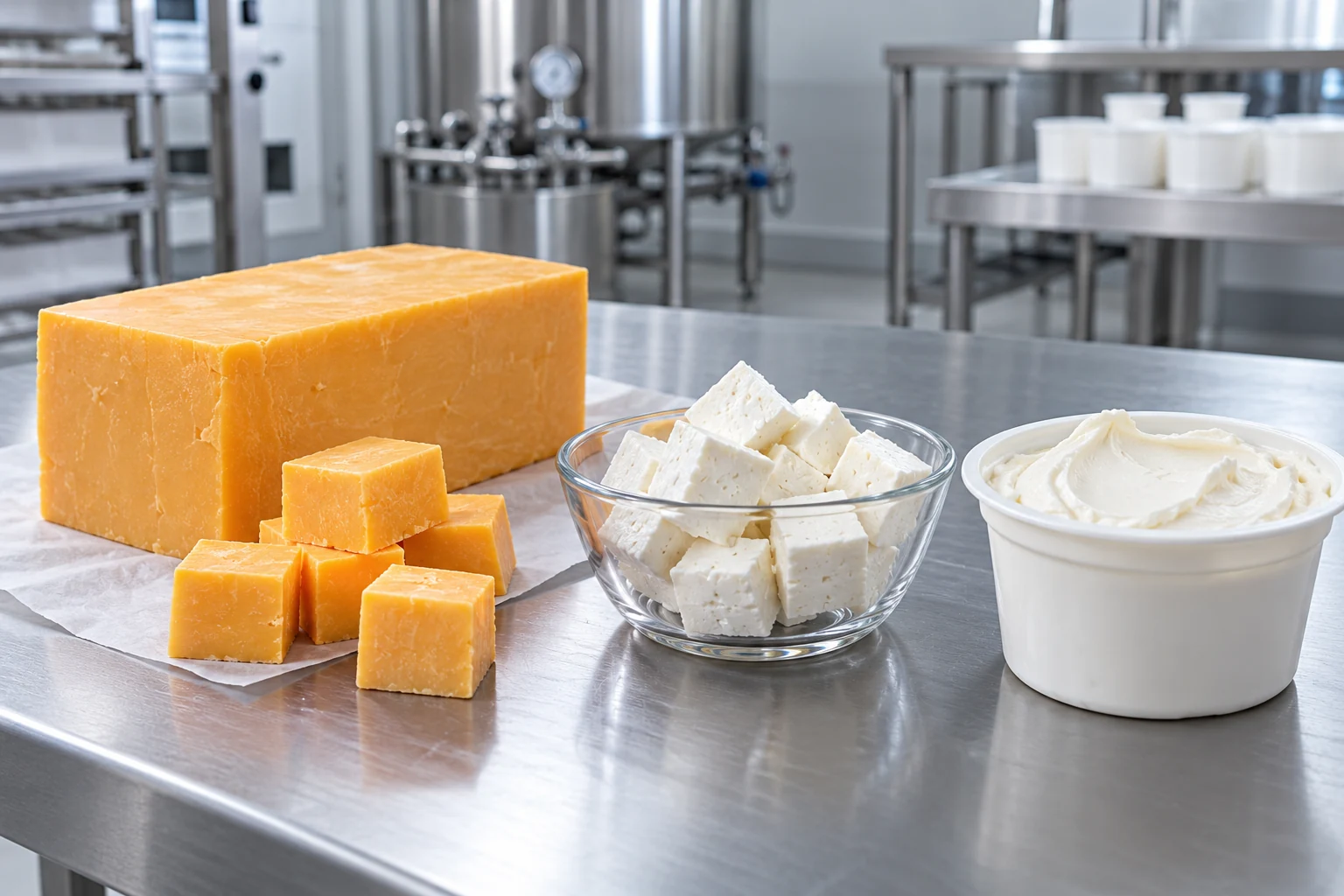
Define traditional curd or specialist concentration / recombination route, product composition, package and cold duty. Similar-looking products can have very different equipment and acceptance requirements.
Map curd, whey, pressing, brining, storage / residence and package operations with specialists. Product residence and storage may govern practical capacity more than one upstream machine.
Review ingredient addition, heating / mixing, viscosity, discharge and the package / preservation route. A liquid / semi-liquid equipment discussion does not establish compatibility with every cheese variety.
Choose the cheese and processing boundary before building the scope or return model.
Locate waits across qualified process packages, product handling, cleaning and storage.
Survey curd / liquid routes, drains, instruments and manual-clean equipment before the cutover.
Review each system by its operating duty and the interfaces to be agreed before procurement.
Product-specific milk / ingredient / whey vessel interfaces.
Process heat, cold and cleaning distribution.
Defined liquid circuits within the cheese operation.
Selected cheese-making / ripening / packaging packages.
Swipe horizontally to compare all columns ↔
| System | Operating duty | Relevant DPS guide | Confirm before purchase |
|---|---|---|---|
| Configured tanks / vessels | Product-specific milk / ingredient / whey vessel interfaces. | DPS tanks & vessels ↗ | Working duty, materials, holding and cleaning. |
| Process utilities and distribution | Process heat, cold and cleaning distribution. | Utility infrastructure planning ↗ | Qualified package duty and simultaneous demand. |
| CIP equipment and circuit interfaces | Defined liquid circuits within the cheese operation. | DPS CIP systems ↗ | Open machinery and manual-clean boundaries. |
| Specialist equipment interfaces | Selected cheese-making / ripening / packaging packages. | Installation & integration ↗ | Product variety, material balance and OEM acceptance. |
Ask suppliers to show final product, accepted material balance, package duty and exclusions. A filtration skid, cheese vat and complete cheese operation have different scope. Compare milk / whey and final-cheese economics on consistent quantities and include refrigeration, storage / residence, field interfaces and qualified trials.
Swipe horizontally to compare all columns ↔
| Buying question | Evidence to prepare | Engineering decision |
|---|---|---|
| What quantity does throughput describe? | Milk feed, curd, concentrate or final cheese. | Use accepted final product in sales economics. |
| Where does whey value belong? | Actual by-product quality, use, quantity and cash cost. | Include a real separate stream without duplicating recovery. |
| What does CIP include? | Installed liquid circuits and manual-clean machinery. | Assign all sanitation and release responsibilities. |
Start with the business outcome
Cheese manufacturers need the complete product train and its material balance understood before equipment prices can be compared. DPS can support scoped vessels, utilities, cleaning, controls and installation interfaces around the qualified cheese-making packages. Investment value should use accepted finished-cheese mass and actual input / by-product costs; milk feed kilograms are not interchangeable with saleable cheese kilograms.
Coagulation, curd handling, separation / filtration, molding, pressing, stretching, brining, ripening and specialist packaging require explicit qualified OEM / product responsibilities as applicable to the variety. No complete cheese-line manufacturing or universal milk-to-cheese yield is claimed for DPS.
Define fresh, ripened or processed cheese requirements, including milk preparation, curd or concentration packages, residence and the final package.
Reconcile milk, cheese, whey and other streams while checking cold services, cleaning circuits and supplier responsibilities.
Evaluate accepted product and packaging, storage or residence availability and whole-line states against the actual limiting stage.
Review the scope, cost assumptions and operating case for your project. The examples and calculators below support early planning and are not DPS quotations.
Use matched product, input / whey balance, residence, utility and package-state evidence. Coordinate retained assets with the specialist process suppliers before selecting components.
Define variety and specialist process / package route, milk supply, whey destination, storage, utilities, cleaning and demand.
Swipe horizontally to compare all columns ↔
| Observed condition | Measure before design | DPS / team decision | Economic basis |
|---|---|---|---|
| Unclear production constraint | Finished-cheese and package-state / residence records. | Compare the actual limiting process or storage step. | Accepted finished product with demand. |
| Milk / ingredient and whey loss | Matched complete material balances. | Define recovery and specialist process changes. | Actual avoided input or by-product value once. |
| Utility / cleaning bottleneck | Delivered conditions and actual resource use. | Correct distribution or circuit / schedule interfaces. | Baseline cash savings and useful accepted time. |
| Fragmented supplier scope | Interface list and qualified acceptance ownership. | Coordinate OEMs, trades and the owner. | Full installation cost and actual operating realization. |
Swipe horizontally to compare all columns ↔
| Decision | Targeted Work | Broader Scope |
|---|---|---|
| Process Constraint | Correct the measured transfer, utility or scheduling interface. | Expand the specialist process or storage stage that limits finished cheese. |
| Material Balance | Establish milk, ingredient, cheese and whey streams. | Include recovery or concentration packages with all by-product responsibilities. |
| Supplier Scope | Resolve retained OEM, utility and cleaning interfaces. | Coordinate a new product route and its complete package and site scope. |
Compare proposals with the same product duty, supplier boundaries and acceptance basis. The amount below is a transparent planning example, not a market price range, supplier estimate or DPS quotation.
| Cost bucket | Assumed amount |
|---|---|
| Product / process and interface engineering | $72,000 |
| Defined configured / OEM component allowance | $252,000 |
| Mechanical / electrical field installation | $138,000 |
| Instrumentation and control integration | $72,000 |
| Commissioning and acceptance support | $42,000 |
| Training, documentation and closeout | $24,000 |
| Defined project scope | $600,000 |
| Separate site / facility additions | $125,000 |
| Capital contingency (15%) | $108,750 |
| Separate one-time startup / shutdown cost | $65,000 |
| Incremental working capital | $40,000 |
| Total initial cash | $938,750 |
The defined scope assumes applicable freight, procurement charges and taxes are included in the owner’s estimate. Add missing civil, land / shell, OEM, environmental, validation and permitting costs explicitly. Site and field conditions, duty, production access and quoted supplier scope determine actual price. Financing is excluded.
Hypothetical owner-budget case: This conservative utility / integration case assumes no incremental product sales; productive time, good-output rate and demand are all zero. Product quantity alone does not establish a profitable output gain. The baseline inputs assume $50,000 energy, $25,000 water / chemistry and $20,000 maintenance reductions per year. Avoided payroll is 1000 hours × $40 × 50% cash realization. Verified baseline purchase reduction contributes $0; its basis is unchanged accepted baseline output. Deduct $25,000 added annual fixed cost. Result: $90,000 steady net benefit; initial cash $938,750 includes the separate site, contingency, startup and working-capital inputs. These are original illustrative assumptions, not a quotation, price benchmark or achieved DPS result.
Calculated from these assumptions: steady annual net benefit $90,000; year-one net cash $55,500; cash payback Beyond 5 years; five-year NPV at 10% is −$628,943. Change the assumptions below to test a different case.
Replace the illustrative inputs with your own measured or quoted values. The five-year pre-tax model uses good kilograms, demand-capped contribution and separately verified baseline savings; it is not a project quotation.
All defaults are illustrative. The default case is an operating-plant improvement, not a greenfield quote. For a new operation, set baseline savings to zero and enter every additional operating and capital cost.
Includes contingency, startup and working capital
Incremental operating cash before tax
Includes year-one ramp assumption
At 10% annual discount
Net annual benefit ÷ initial cash
Net cumulative gain ÷ initial cash
Modeled incremental sales: 0 kg/year at $0.00/kg contribution. The base case does not recover the required discounted return within five years. Year-one net cash: $55,500.
Realization needed for the target operating payback
Not feasible
Demand, time, contribution or other cash benefits cannot meet the 5-year target under these assumptions.
CSV export is local. No inputs are submitted.
Swipe the chart to compare all five years ↔
Swipe horizontally to compare all columns ↔
| Year | Net cash | Cumulative cash | Discounted cash |
|---|---|---|---|
| Initial | −$938,750 | −$938,750 | −$938,750 |
| Year 1 | $55,500 | −$883,250 | $50,455 |
| Year 2 | $90,000 | −$793,250 | $74,380 |
| Year 3 | $90,000 | −$703,250 | $67,618 |
| Year 4 | $90,000 | −$613,250 | $61,471 |
| Year 5 | $90,000 | −$523,250 | $55,883 |
Swipe horizontally to compare all columns ↔
| Case | Annual benefit | NPV | Cash payback |
|---|---|---|---|
| Downside | $90,000 | −$795,693 | Beyond 5 years |
| Base | $90,000 | −$628,943 | Beyond 5 years |
| Upside | $90,000 | −$628,943 | Beyond 5 years |
Downside: installed and site costs +20%, realization ×0.75 and unit contribution reduced by 20% of its absolute value. Upside: realization ×1.15, capped at 100%, and unit contribution improved by 10% of its absolute value. The demand ceiling still applies.
The default reproduces the main retrofit energy input of $50,000/year before added maintenance. The narrow worksheet is not a product-process calculation and does not automatically transfer values into the ROI model. Additional annual service is included in the main added-fixed-cost allowance; deduct it once.
Prepare the information below, export the assumptions you have modeled, and discuss the unknowns with DPS. An unmeasured input is a question to resolve, not a reason to invent precision.
Checklist and model data stay in this browser until you choose to share them.
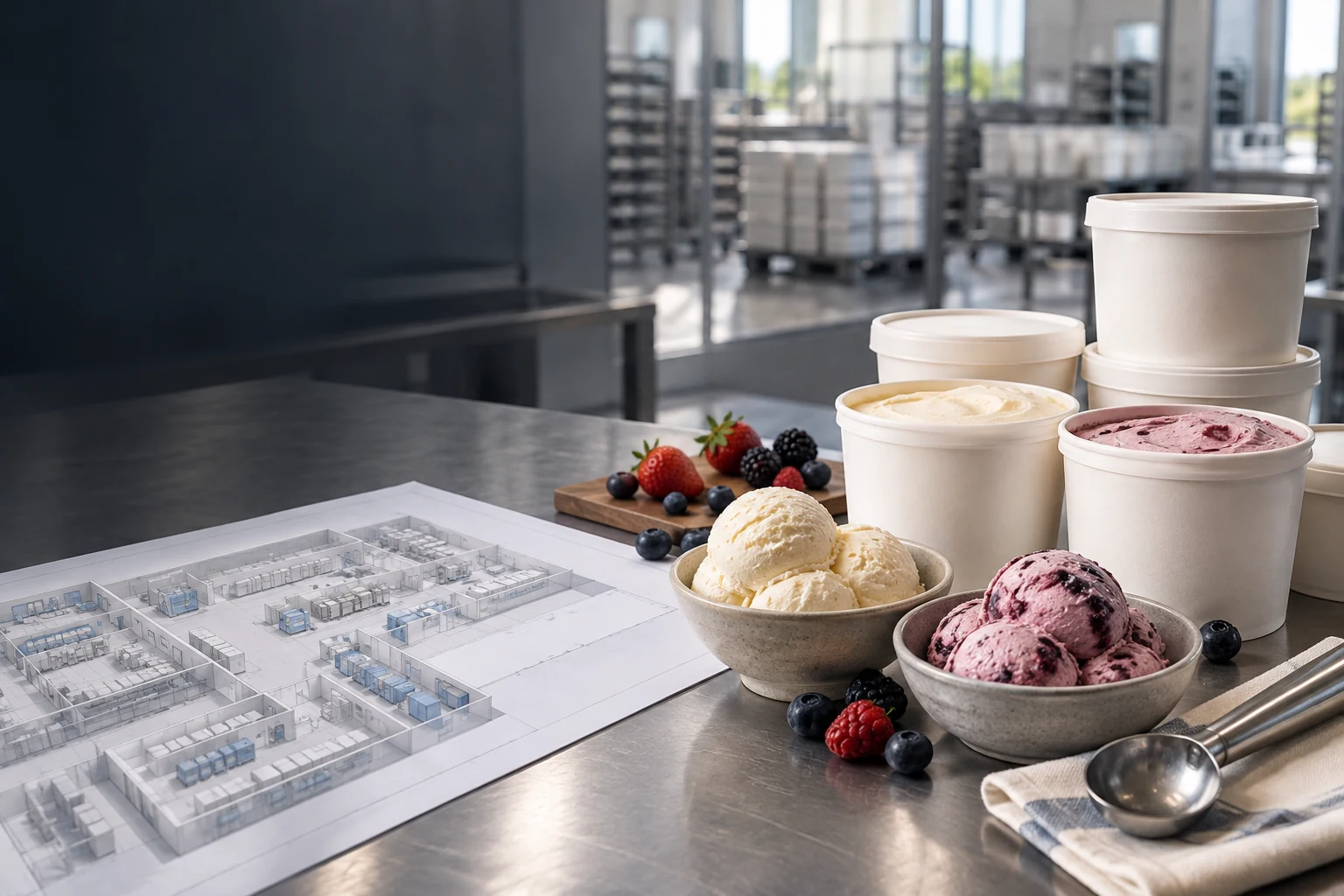
Balance ice cream mix, freezing, hardening and cold storage; connect DPS vessels and integration services with a grounded four-system project lesson.
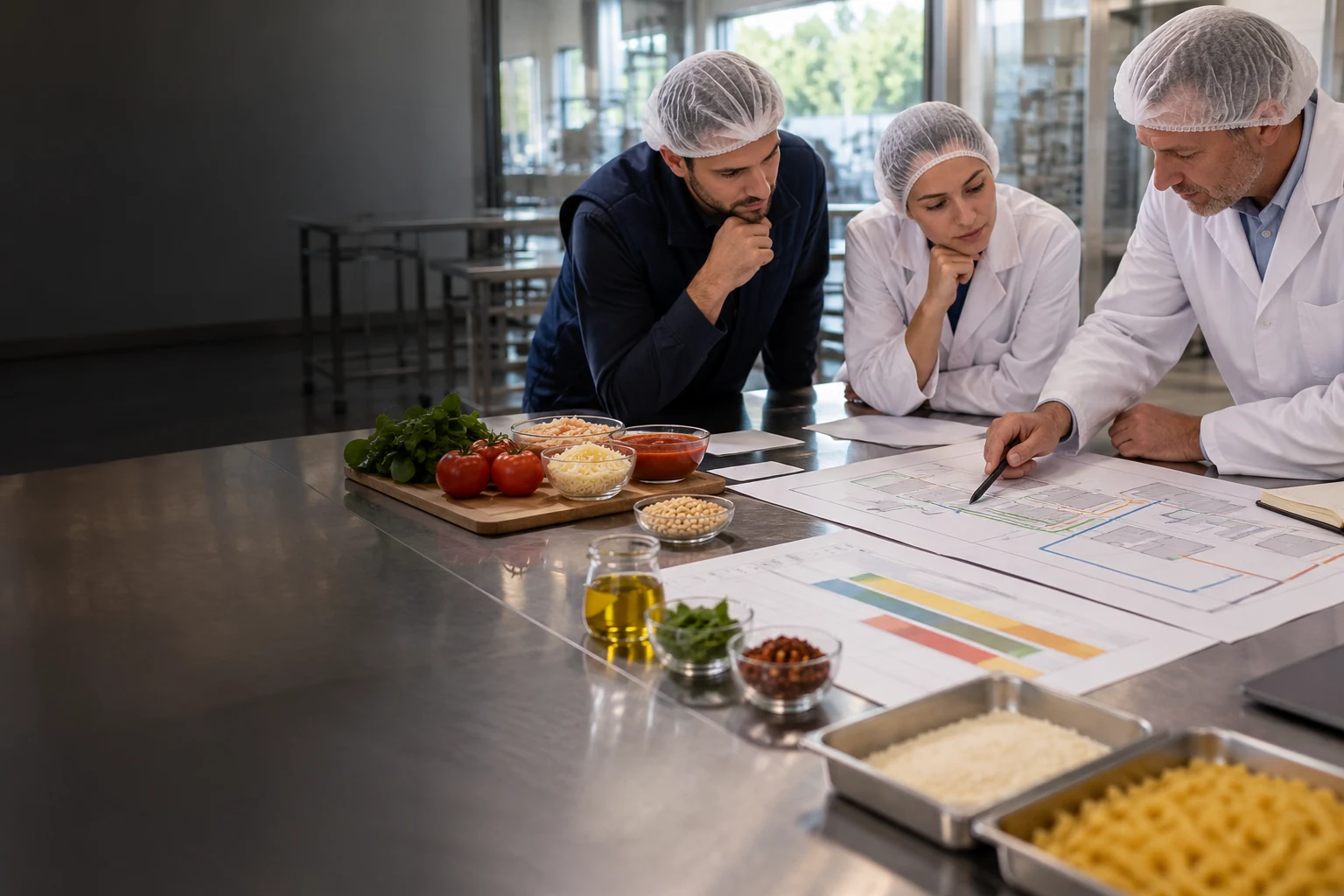
Define a food plant utility design basis using operating events, simultaneous peaks, supply conditions, future capacity and clear package interfaces.
Plan one-time food plant startup costs for staffing preparation, training, trials and launch readiness, separately from working capital and ramp-up losses.
Bring your product requirements, operating priorities and site constraints to an initial scope discussion with DPS.