For owners, operations, engineering & financePlanning guide / North America
How DPS can scope the process and investment decision.
Start with the business outcome
A production concept exists but the product mix, site, utilities, supplier interfaces and launch cash have not been resolved together. Compare a new facility with feasible use of an existing shell or outsourced capacity before freezing the footprint. A site that looks inexpensive can move cost into drainage, utility service, fire protection, access and commissioning. DPS can connect the process basis, capital alternatives, field / supplier interfaces, controls and project execution so the owner can make a reviewable investment decision.
This is a food / beverage facility planning guide. DPS’s published engineering, capital planning, construction / integration and project-delivery scope provides the service context. Specialist product / preservation packages, building approvals and product release require named qualified parties; the hypothetical plant budget is not evidence that DPS manufactures every package.
Food plant design basis: connect product, site and operating model.
Qualified product and package
Specify ingredient behavior, preservation / storage objective, formats, supplier responsibilities and acceptance with the qualified team. The full production train must fit those requirements before layout or procurement is frozen.
Operable production schedule
Build preparation, process, residence, transfer, CIP, packaging and staffing into one calendar. Use accepted product mass at the constrained line rate; clarify which tasks can overlap and which require separate assets.
Funding and site readiness
Scope land / shell or lease responsibilities, fit-out, utilities, civil work, specialist OEMs, launch resources and working capital. A lower machine purchase amount is not a lower complete new-operation cash requirement.
Process layout, site readiness and startup planning.
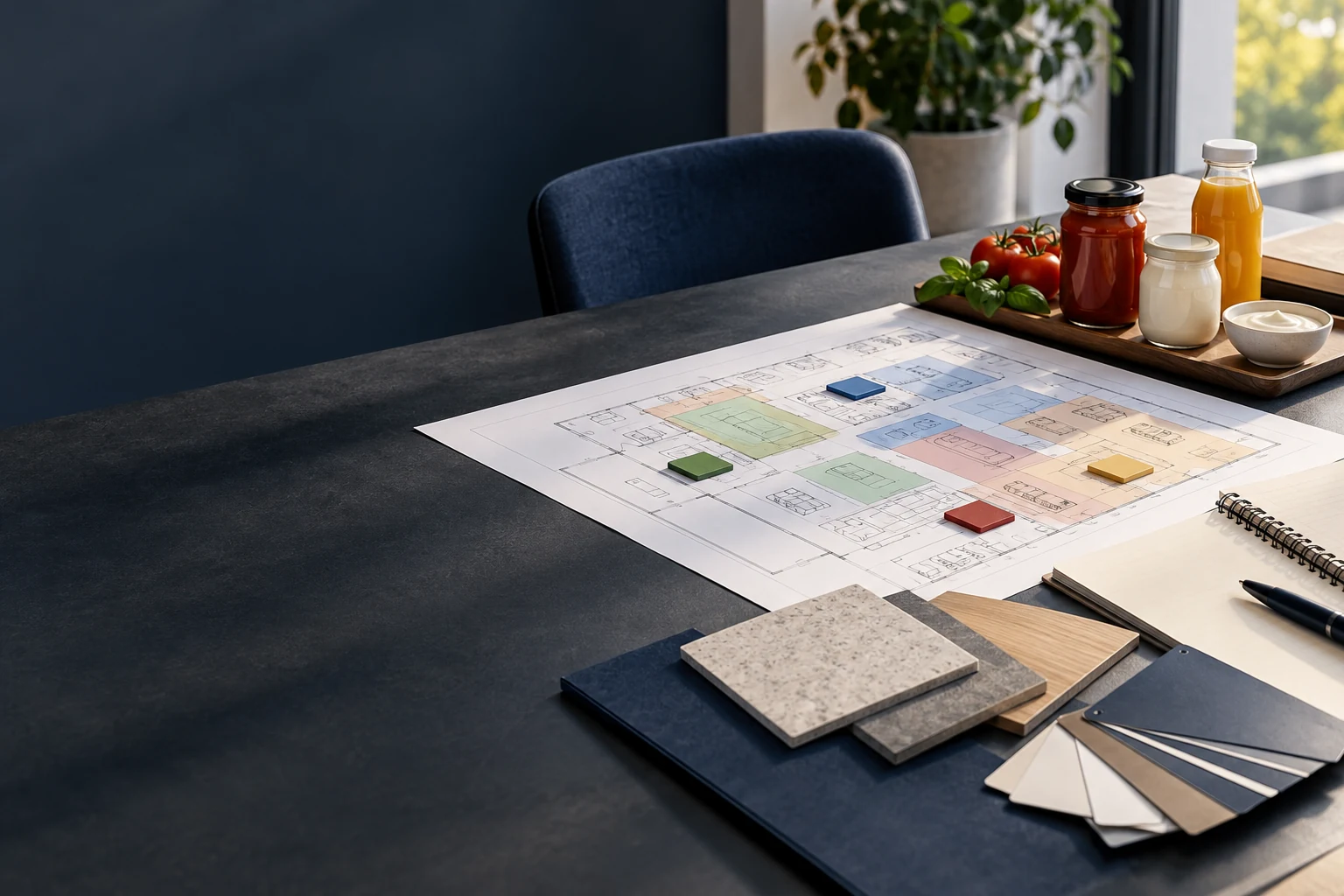
Turn the qualified product and package requirements into process blocks, asset duties, hygiene / material flow and maintenance access.
Define qualified productsRecord the evidence needed for this stage.
Map the complete process trainAssign the responsible qualified owner or supplier.
Lay out flow and accessTest against the agreed product and operating conditions.
Agree equipment / site basisDocument the decision before progressing.
Resolve before procurementProduct and package requirements precede a detailed architectural equipment arrangement.
Check real service availability, routes, specialist packages, access and construction boundaries with responsible parties.
Survey the actual shellRecord the evidence needed for this stage.
Confirm service availabilityAssign the responsible qualified owner or supplier.
Assign landlord and supplier workTest against the agreed product and operating conditions.
Compare complete funded scopeDocument the decision before progressing.
Resolve before procurementCompare service delivery, enabling construction and equipment lead times before accepting the launch date.
Connect source / distribution tests, package handshakes, product trials, training and the site release process.
Verify building and utilitiesRecord the evidence needed for this stage.
Test package handshakesAssign the responsible qualified owner or supplier.
Run qualified product trialsTest against the agreed product and operating conditions.
Train and hand over operationDocument the decision before progressing.
Resolve before procurementMechanical completion is one gate; accepted production and supported operation are the business objective.
Equipment duties, utilities and supplier responsibilities.
Swipe horizontally to compare all columns ↔
Select by operating duty and agreed supplier scope
System
Operating duty
Relevant DPS guide
Confirm before purchase
Capital alternatives
Compare site, shell, timing, capacity and launch cash.
Proposal scope: operating evidence and acceptance responsibilities.
Start with qualified product and packaging requirements, good kg per shift, customer demand and the complete process / CIP schedule. Supplier nameplate output and forecast sales are different inputs.
Swipe horizontally to compare all columns ↔
Project-specific decision and acceptance register
Decision area
Operating / site evidence
Acceptance or responsibility
Product / package basis
Define preservation route, ingredients, formats and accepted output.
Qualified process and OEM review before purchasing.
Site feasibility
Investigate utility availability, drainage, structural and access constraints.
Owner-approved site basis and estimate.
Production train
Connect preparation, processing, cleaning and packaging.
Whole-line duty, not one fast machine.
Financial readiness
Include shell, fit-out, OEMs, labor, ramp and working capital.
Compare all feasible options on equal scope.
Product / package basis, site feasibility and operating value.
Swipe horizontally to compare all columns ↔
Value-driver and responsibility map
Observed condition
Measure before design
DPS / team decision
Economic basis
Product / package basis
Define preservation route, ingredients, formats and accepted output.
Qualified process and OEM review before purchasing.
Use the matched product / site baseline and the agreed counterfactual.
Site feasibility
Investigate utility availability, drainage, structural and access constraints.
Owner-approved site basis and estimate.
Include complete capital and one-time transition cash.
Production train
Connect preparation, processing, cleaning and packaging.
Whole-line duty, not one fast machine.
Count only independent cash costs actually avoided or useful sold output.
Financial readiness
Include shell, fit-out, OEMs, labor, ramp and working capital.
Compare all feasible options on equal scope.
Separate recurring operating benefit from one-time project exposure.
Compare site, staging and complete operating scope.
Compare a new facility with feasible use of an existing shell or outsourced capacity before freezing the footprint. A site that looks inexpensive can move cost into drainage, utility service, fire protection, access and commissioning.
Investment boundaryInclude every additional fixed operating cost. The example’s annual fixed $850,000 represents $550,000 fixed payroll / supervision, $200,000 occupancy / overhead and $100,000 service / fixed operation. Variable production costs are separate.
Start with qualified product and packaging requirements, good kg per shift, customer demand and the complete process / CIP schedule. Supplier nameplate output and forecast sales are different inputs.
Investment boundaryEvaluate total cash, useful operating life, supplier readiness and realistic customer demand. Later equipment or construction capital must remain visible in the approval cash flow.
Food & beverage plant design: installed cost and budget scope.
Compare proposals with the same product duty, supplier boundaries and acceptance basis. The amount below is a transparent planning example, not a market price range, supplier estimate or DPS quotation.
Illustrative scope-based budget / USD
Cost bucket
Assumed amount
Process / site / supplier engineering
$420,000
Defined process / OEM equipment allowance
$960,000
Field installation and utility connections
$750,000
Controls / instrument integration
$420,000
Supplier commissioning / owner readiness
$300,000
Documentation and project closeout
$150,000
Defined project scope
$3,000,000
Separate site / facility additions
$1,500,000
Capital contingency (15%)
$675,000
Separate one-time startup / shutdown cost
$180,000
Incremental working capital
$300,000
Total initial cash
$5,655,000
The defined scope assumes applicable freight, procurement charges and taxes are included in the owner’s estimate. Add missing civil, land / shell, OEM, environmental, validation and permitting costs explicitly. Site and field conditions, duty, production access and quoted supplier scope determine actual price. Financing is excluded.
Worked operating case
Hypothetical case for new food factory engineering and construction: 250 days × 7 useful hour/day × 1,500 accepted kg/h × 60% realization gives 1,575,000 kg potential extra sales; the 1,600,000 kg demand ceiling yields 1,575,000 sold kg/year. Net price $4.50 less $2.90 incremental variable cost gives $1.60/kg contribution. Separately verified baseline energy / cleaning / maintenance assumptions are $0/year; actual paid-hour avoidance is $0/year. Added fixed operating cost is $850,000/year, and year-one gross benefit realizes at 45%. These values are original owner-planning assumptions, not supplier prices or a customer result.
Calculated from these assumptions: steady annual net benefit $1,670,000; year-one net cash $284,000; cash payback 4.22 years; five-year NPV at 10% is −$584,386. Change the assumptions below to test a different case.
Replace the illustrative inputs with your own measured or quoted values. The five-year pre-tax model uses good kilograms, demand-capped contribution and separately verified baseline savings; it is not a project quotation.
USD / 5-year screening model / pre-tax, unlevered
new food factory engineering and construction new-facility example
All defaults are illustrative. The initial preset is a new-operation case. It assumes no historical operating savings and includes the defined full additional fixed operating cost. For a new operation, set baseline savings to zero and enter every additional operating and capital cost.
Initial cash investment
$5.66M
Includes contingency, startup and working capital
Steady annual net benefit
$1.67M
Incremental operating cash before tax
Cash payback
4.22 years
Includes year-one ramp assumption
5-year NPV
−$584.4k
At 10% annual discount
Steady annual cash ROI
29.5%
Net annual benefit ÷ initial cash
5-year net cash ROI
23.1%
Net cumulative gain ÷ initial cash
Modeled incremental sales: 1,575,000 kg/year at $1.60/kg contribution. The base case does not recover the required discounted return within five years. Year-one net cash: $284,000.
Realization needed for the target operating payback
53.0%
Minimum capacity realization for a 5-year operating cash payback; terminal recovery excluded. Demand and unit margin must also hold.
CSV export is local. No inputs are submitted.
Cumulative project cash
BaseDownside
Swipe the chart to compare all five years ↔
Undiscounted cumulative cash. NPV separately discounts year-end flows; working-capital recovery defaults to zero.Inspect annual cash flow and sensitivity
Swipe horizontally to compare all columns ↔
Base-case cash flows
Year
Net cash
Cumulative cash
Discounted cash
Initial
−$5,655,000
−$5,655,000
−$5,655,000
Year 1
$284,000
−$5,371,000
$258,182
Year 2
$1,670,000
−$3,701,000
$1,380,165
Year 3
$1,670,000
−$2,031,000
$1,254,696
Year 4
$1,670,000
−$361,000
$1,140,632
Year 5
$1,670,000
$1,309,000
$1,036,939
Swipe horizontally to compare all columns ↔
Sensitivity assumptions are not forecasts
Case
Annual benefit
NPV
Cash payback
Downside
$662,000
−$4,936,499
Beyond 5 years
Base
$1,670,000
−$584,386
4.22 years
Upside
$1,966,000
$389,687
3.66 years
Downside: installed and site costs +20%, realization ×0.75 and unit contribution reduced by 20% of its absolute value. Upside: realization ×1.15, capped at 100%, and unit contribution improved by 10% of its absolute value. The demand ceiling still applies.
Formulas, scope and double-counting rules
Initial cash = (defined project scope + site additions) × (1 + contingency) + separate startup / shutdown cost + working capital. Contingency is conservatively treated as spent initially.
Sold incremental kg = min(days × recovered hours/day × constrained good kg/hour × realization, incremental demand). Contribution = sold incremental kg × (net price − incremental variable cost). New-volume labor, energy and packaging belong in that variable cost.
Baseline material benefit uses the verified percentage of actual purchases avoided at unchanged accepted baseline output. It is not a direct subtraction of two loss rates. Count a recovered kilogram once, either as its applicable cash saving or as incremental contribution.
Net annual benefit = contribution + independently realized baseline cash savings − added fixed operating cost. Year one scales gross benefits by the ramp factor while paying the full added fixed operating cost. Do not also count the same launch loss in the one-time startup amount.
Cash ROI = net annual benefit / initial cash. Five-year net ROI = (five-year cash inflows − initial cash) / initial cash. NPV = −initial cash + Σ cash flow(t)/(1 + discount rate)^t. Payback uses annual cash with linear interpolation within the recovery year. The threshold solver excludes terminal working-capital recovery.
This is a five-year screening horizon, not an asset’s entire life. No tax, debt, depreciation, grants, escalation, asset resale or additional replacement capital is modeled. Include recurring service costs in operating expense and use a detailed monthly budget for formal capital approval.
New food plant scheduled-capacity worksheet
The worksheet shows gross scheduled good-output capacity before commercial realization and demand. For this new-operation preset, “productive minutes per block” is planned operating time, not a saving from a previous plant.
Commissioning tests and performance acceptance.
Agree the design basis.
Use representative products, measured constraints and a documented utility / cleaning envelope. Assign each supplier and owner interface.
Test the complete sequence.
Plan FAT / SAT, instruments, recipes, permissives, quality checks and upstream / downstream handshakes as appropriate to the scope.
Verify economic realization.
After stabilization, compare matched products and operating conditions. Reconcile extra output with sales, and baseline savings with actual purchases, bills and payroll.
Published scope / project context
DPS publishes food / beverage project, process, utility, installation and controls context. Those materials establish relevant delivery disciplines. None of the amounts, recovered time, energy reductions, schedules or payback in this original screening example is attributed to a customer case.
Compare installed scope, continuity and useful life.
Swipe horizontally to compare all columns ↔
Decision framework, not a guaranteed cost comparison
Decision
Targeted intervention
Broader replacement / new operation
Constraint
A measured gap can be corrected within retained assets.
The verified operating envelope cannot meet product, demand or reliability needs.
Cost scope
Include engineering, interfaces, shutdown, commissioning and retained-asset risk.
Include all new systems, site / facility work, OEMs, utilities, ramp and working capital.
Benefit
Only incremental contribution and genuinely avoided costs versus the current operation.
Demand-supported contribution less the full additional operating cost versus the agreed alternative.
Acceptance
Verify the changed duty and its effect on the complete line.
Verify the integrated new train and the owner’s readiness to operate.
Food & Beverage Plant Design and Construction FAQ
Practical project questions
What determines the cost of building a food factory?
Compare a new facility with feasible use of an existing shell or outsourced capacity before freezing the footprint. A site that looks inexpensive can move cost into drainage, utility service, fire protection, access and commissioning.
How do we compare an existing shell with a new building?
Start with qualified product and packaging requirements, good kg per shift, customer demand and the complete process / CIP schedule. Supplier nameplate output and forecast sales are different inputs.
When should equipment procurement begin?
Include every additional fixed operating cost. The example’s annual fixed $850,000 represents $550,000 fixed payroll / supervision, $200,000 occupancy / overhead and $100,000 service / fixed operation. Variable production costs are separate. This is a food / beverage facility planning guide. DPS’s published engineering, capital planning, construction / integration and project-delivery scope provides the service context. Specialist product / preservation packages, building approvals and product release require named qualified parties; the hypothetical plant budget is not evidence that DPS manufactures every package.
Are these prices or returns a DPS commitment?
No. The example inputs exist to make the business-case calculation reviewable. Actual scope, prices, schedule, savings and performance need project-specific assessment and agreement.
What should the first DPS conversation include?
Bring the product and package mix, operating baseline, commercial target, retained assets, site constraints, available outage window and the capital options you are considering. Mark unknowns for measurement or supplier trials.
Prepare a new food factory engineering and construction project brief.
Prepare the information below, export the assumptions you have modeled, and discuss the unknowns with DPS. An unmeasured input is a question to resolve, not a reason to invent precision.
Checklist and model data stay in this browser until you choose to share them.
Sources, assumptions and further reading.
DPS manufacturing scenario and delivery scope
The DPS manufacturing-scenarios overview and linked service descriptions support engineering / integration context. The site-specific findings, illustrative financial assumptions and decision register on this page require project assessment; they are not published DPS customer results.
Guide assumptions reviewed on 26 October 2026. Qualified site / product teams establish regulatory and food-safety requirements; this guide does not prescribe a validated process.